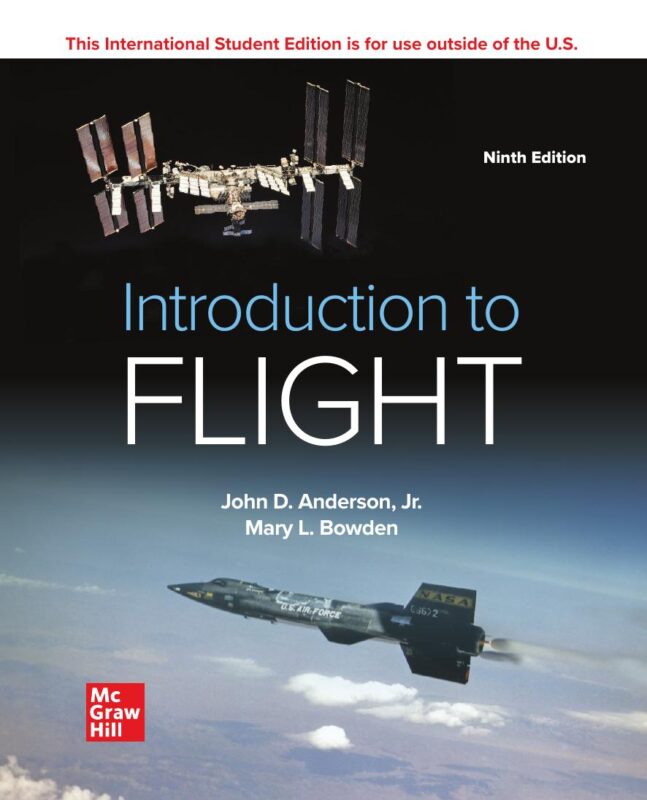
Introduction to Flight 9th Edition ISE By John D. Anderson Jr., Mary L. Bowden eBook
$30.00
Secure checkout
Instant digital download
PDF document
Document details
- Pages
- 961
- File size
- 11.5 MB
- Format
- Digital PDF
- Course
- Education
- Category
- eBook[PDF]
Sign in or create a free account to continue. Your purchase will be saved in My Downloads.
About this ebook
Introduction to Flight (9th Edition, International Student Edition) by John D. Anderson Jr. and Mary L. Bowden covers the foundational principles of aerospace engineering through a blend of technical theory, analytical tools, and historical context. [1, 2]
The primary topics covered across the textbook's 10 main chapters include:
1. Aerospace History & Fundamental Concepts
- The First Aeronautical Engineers: Early pioneers and the historical evolution of flight technology.
- Fundamental Thoughts: Source of aerodynamic forces, equations of state, and basic fluid mechanics concepts.
- The Standard Atmosphere: Atmospheric structure, pressure, density, temperature variations, and altitude definitions. [, 2]
2. Aerodynamics & Airfoil Theory
- Basic Aerodynamics: Continuity, momentum, and energy equations, alongside subsonic, supersonic, and hypersonic flow principles.
- Airfoils, Wings, and Other Aerodynamic Shapes: Lift, drag, and moment coefficients, finite wing theory, and induced drag. [1, 2]
3. Aircraft Performance & Flight Dynamics
- Elements of Airplane Performance: Drag curves, power required vs. power available, rate of climb, range, endurance, and takeoff/landing mechanics.
- Principles of Stability and Control: Static and dynamic stability, longitudinal, directional, and lateral control surfaces. [1, 2]
4. Propulsion & Space Flight
- Aircraft Propulsion: Piston engines, propellers, turbojets, turbofans, ramjets, and rocket propulsion mechanics.
- Astronautics (Space Flight): Orbital mechanics, Kepler's laws, satellite trajectories, and space vehicle launch profiles.
- Hypersonic Vehicles & Advanced Flight: Atmospheric re-entry physics and high-speed aerospace vehicle design. [1, 2]
🆕 Key Updates in the 9th Edition
- Expanded coverage of space flight design tools for preliminary space missions.
- Enhanced historical sections focusing on early aerodynamic drag research and the development of human space flight.
- Revised and updated problem sets at the end of Chapters 8 and 9. [1]
File included
tmpphpYNAbgn
11.5 MB
Related ebooks