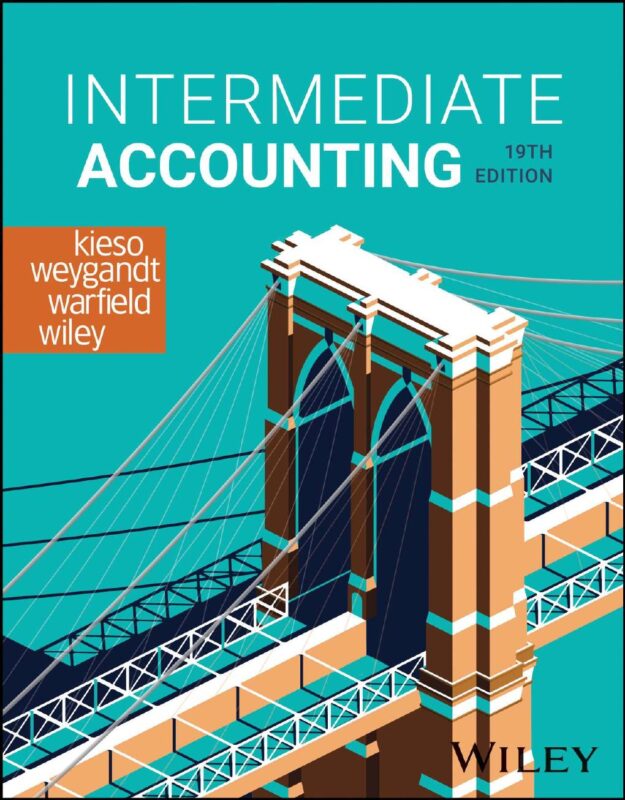
Intermediate Accounting 19th Edition By Donald E. Kieso, Jerry J. Weygandt | eBook
$30.00
Secure checkout
Instant digital download
PDF document
Document details
- Pages
- 1,646
- File size
- 34.67 MB
- Format
- Digital PDF
- Course
- Accounting
- Category
- eBook[PDF]
Sign in or create a free account to continue. Your purchase will be saved in My Downloads.
About this ebook
The 19th Edition of Intermediate Accounting by Donald E. Kieso, Jerry J. Weygandt, Terry D. Warfield, and Laura D. Wiley serves as the definitive gold standard for financial accounting education. Spanning 23 comprehensive chapters, the text covers foundational accounting theories, the identification and recording of economic transactions, in-depth asset and liability management, equity, and advanced financial reporting topics. [1, 2, 3, 4]
The curriculum is structured across the following core areas:
📖 Foundational Framework & Systems
- Financial Accounting and Accounting Standards: Role of the financial reporting environment, GAAP, and oversight bodies (FASB, SEC).
- Conceptual Framework for Financial Reporting: Standard objectives, qualitative characteristics of accounting information, and measurement concepts.
- The Accounting Information System: The accounting cycle, double-entry bookkeeping, ledger adjustments, trial balances, and closing entries. [1]
- Income Statement and Related Information: Reporting format, measuring profitability, discontinued operations, and earnings quality. [1]
- Balance Sheet and Statement of Cash Flows: Financial positioning, liquidity analysis, risk assessment, and basic cash flow categorizations. [1, 2]
- Accounting and the Time Value of Money: Future and present value concepts applied to financial valuations.
📊 Asset Recognition and Valuation
- Cash and Receivables: Management of cash, revenue-related receivables, allowances for doubtful accounts, and financing arrangements.
- Valuation of Inventories: Cost basis methods (FIFO, LIFO, average-cost), lower-of-cost-or-net-realizable-value, and estimation techniques.
- Acquisition and Disposition of Property, Plant, and Equipment: Capitalization of costs, self-constructed assets, interest capitalization, and asset disposals.
- Depreciation, Impairments, and Depletion: Allocating operational asset costs, assessing asset impairment losses, and natural resource accounting.
- Intangible Assets: Amortization policies, goodwill valuation, and internal R&D accounting. [1, 2]
⚖️ Liabilities, Equity, and Capital Securities
- Current Liabilities and Contingencies: Short-term obligations, payroll accounting, and estimating contingent obligations.
- Long-Term Liabilities: Accounting for bonds payable, notes payable, extinguishing debt, and long-term debt modifications.
- Stockholders' Equity: Issuing stock, treasury stock transactions, dividend policies, and retained earnings restrictions.
- Dilutive Securities and Earnings per Share: Convertible instruments, stock warrants, stock options, and calculating basic vs. diluted EPS.
- Investments: Debt securities (held-to-maturity, trading, available-for-sale) and equity securities investments. [1, 2]
🔄 Advanced Reporting & Measurement Concepts
- Revenue Recognition: Five-step model application, contract assets/liabilities, and multi-element arrangements.
- Accounting for Income Taxes: Deferred tax assets and liabilities, temporary vs. permanent differences, and net operating losses.
- Accounting for Pensions and Postretirement Benefits: Defining benefits obligations, plan asset returns, and pension expense calculations.
- Accounting for Leases: Right-of-use asset models, lessee and lessor operational and financial classifications.
- Accounting Changes and Error Analysis: Retrospective shifts, prospective adjustments, and correction of financial statement errors.
- Statement of Cash Flows (Advanced): Indirect and direct preparation methods, operating, investing, and financing details.
- Full Disclosure in Financial Reporting: Footnote requirements, segment reporting, subsequent events, and auditor reports. [1, 2, 3]
🚀 Modern Themes Integrated into the 19th Edition
Unlike older iterations, this edition explicitly threads cutting-edge industry shifts directly into the core modules: [1, 2]
- ESG (Environmental, Social, and Governance): How corporate sustainability and climate impact tracking intersect with formal disclosures. [1, 2]
- Crypto Assets: The recognition, balance sheet presentation, and fair value adjustments required for digital assets. [1, 2]
- Artificial Intelligence & Data Analytics: Exercises incorporating Power BI, Tableau, and specialized Excel assignments to handle tech-driven auditing and reporting. [1]
File included
tmpphplicTMt
34.67 MB
Related ebooks