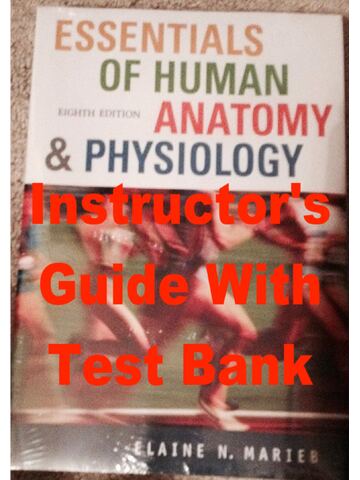
Instructor’s Guide With Test Bank for Essentials Of Human Anatomy And Physiology. 8th Edition 2006
$24.00
Secure checkout
Instant digital download
PDF document
Document details
- File size
- 26.6 MB
- Format
- Digital PDF
- Course
- Anatomy
- Category
- TEST BANKS
Sign in or create a free account to continue. Your purchase will be saved in My Downloads.
About this ebook
The Instructor's Guide with Test Bank for Essentials of Human Anatomy and Physiology (8th Edition, 2006) by Elaine N. Marieb covers the foundational structures and chemical functions of the human body. It acts as a comprehensive resource featuring teaching tools, lecture outlines, and multi-format exam questions (multiple-choice, true/false, matching, and short answer) mapped directly across 16 core thematic chapters. [1, 2, 3]
📚 Core Topics and Chapter Breakdown
🧬 Foundations of Human Biology
- Chapter 1: The Human Body: An Orientation – Levels of structural organization, organ system overview, survival needs, anatomical position, directional terminology, and the mechanics of homeostasis. [1, 2]
- Chapter 2: Basic Chemistry – Matter, energy, atomic structure, chemical bonds, biochemistry (carbohydrates, lipids, proteins, nucleic acids), and the function of ATP. [1, 2]
- Chapter 3: Cells and Tissues – Anatomy of a generalized cell, membrane transport mechanisms, cell division, protein synthesis, and the four primary tissue types (epithelial, connective, muscle, nervous). [1, 2]
🦴 Support, Movement, and Integration
- Chapter 4: Skin and Body Membranes – Classification of epithelial and connective tissue membranes, structure/function of the integumentary system (skin), and homeostatic imbalances (burns, skin cancer). [1, 2]
- Chapter 5: The Skeletal System – Bone formation, growth, and remodeling; axial and appendicular skeleton division; structure of joints. [1, 2]
- Chapter 6: The Muscular System – Microscopic anatomy of skeletal muscle, mechanism of muscle contraction, body movements, and naming conventions for major skeletal muscles. [1, 2]
🧠 Control and Regulation
- Chapter 7: The Nervous System – Organization of the central (CNS) and peripheral (PNS) nervous systems; nerve impulse propagation; brain anatomy, spinal cord, and autonomic functions.
- Chapter 8: Special Senses – Anatomy and physiology of vision (the eye), hearing and equilibrium (the ear), olfaction (smell), and gustation (taste).
- Chapter 9: The Endocrine System – Mechanisms of hormone action, homeostatic regulation via negative feedback, and functions of the major endocrine glands (pituitary, thyroid, adrenal, pancreas, etc.). [1, 2]
🫀 Transport and Body Defenses
- Chapter 10: Blood – Composition and functions of plasma, formed elements (erythrocytes, leukocytes, platelets), hemostasis, and blood typing.
- Chapter 11: The Cardiovascular System – Internal and external anatomy of the heart, blood flow pathway, cardiac cycle, and the dynamics of blood vessels and circulation.
- Chapter 12: The Lymphatic System and Body Defenses – Lymphatic vessels and nodes; the innate (nonspecific) body defenses; adaptive (specific) immunity pathways. [1, 2, 3, 4]
🌬️ Environmental Exchange and Fluid Maintenance
- Chapter 13: The Respiratory System – Functional anatomy of respiratory organs, mechanics of breathing, gas transport in blood, and control of respiration.
- Chapter 14: The Digestive System and Body Metabolism – Anatomy of the alimentary canal and accessory organs; ingestion, digestion, absorption, and cellular metabolism.
- Chapter 15: The Urinary System – Kidney structure and nephron function, urine formation, fluid/electrolyte balance, and acid-base balance of blood. [1, 2]
File included
Instructors-Guide-With-Test-Bank-for-Essentials-Of-Human-Anatomy-And-Physiology.-8th-Edition-2006.pdf
26.6 MB
Related ebooks