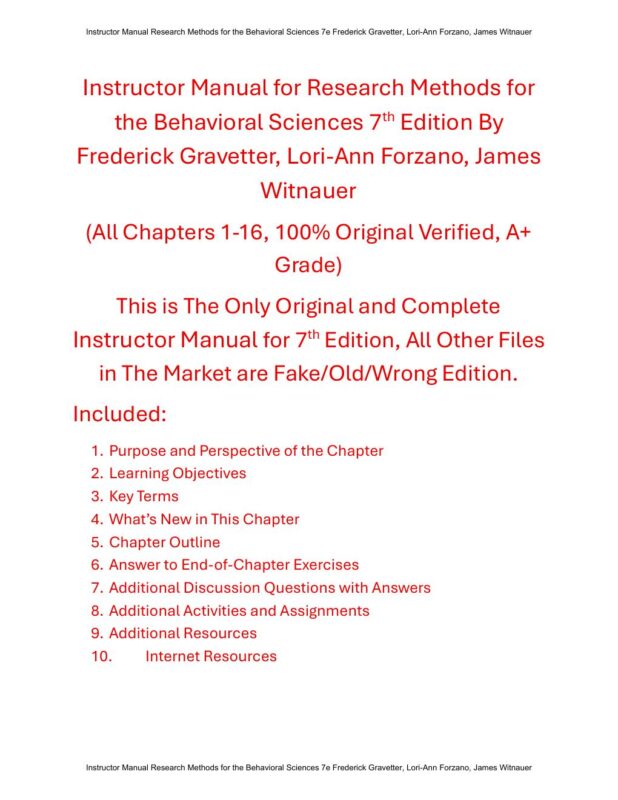
Instructor Manual for Research Methods for the Behavioral Sciences 7th Edition By Frederick Gravetter, Lori-Ann Forzano, James Witnauer
$30.00
Secure checkout
Instant digital download
PDF document
Document details
- Pages
- 242
- File size
- 5.5 MB
- Format
- Digital PDF
- Course
- Psychology
- Category
- INSTRUCTOR MANUALS
Sign in or create a free account to continue. Your purchase will be saved in My Downloads.
About this ebook
Instructor Manual for Research Methods for the Behavioral Sciences (7th Edition) by Frederick Gravetter and Lori-Ann Forzano covers the entire scientific research process step-by-step. The textbook walks students from initial idea generation through study design, execution, statistical analysis, and final report writing. [1, 2]
A core update to this 7th edition teaches students how to execute data analysis specifically tailored to their research design using R, SPSS, or manual calculations. [1]
The major topics and core chapters covered in the text include: [1]
Foundations of Behavioral Research
- The Scientific Method: Introduction to acquiring knowledge, forming hypotheses, and using empirical methods.
- Research Ideas: Tips and strategies for identifying research topics, conducting literature reviews, and building testable hypotheses.
- Defining and Measuring Variables: Operational definitions, measurement scales, and establishing reliability and validity.
- Ethics in Research: Historical background, institutional review boards (IRBs), human participant protections, and animal research ethics.
- Selecting Participants: Sampling techniques, probability vs. non-probability sampling, and defining target populations. [1, 2, 3, 4, 5]
Research Strategies and Design
- Validity of Research: Understanding the balance between internal validity (control) and external validity (generalizability). [1, 2]
- The Experimental Research Strategy: Establishing cause-and-effect relationships through independent variable manipulation and controlling confounds. [1, 2]
- Between-Subjects Designs: Comparing different groups of participants across experimental conditions. [1]
- Within-Subjects Designs: Testing the same group of participants across multiple conditions, managing order effects, and counterbalancing. [1, 2]
- Factorial Designs: Examining complex studies that involve multiple independent variables simultaneously. [1, 2]
Non-Experimental and Descriptive Methods
- Nonexperimental and Quasi-Experimental Strategies: Methods used when random assignment is impossible, including non-equivalent groups, pre-post testing, and developmental designs (cross-sectional and longitudinal).
- The Correlational Research Strategy: Measuring the strength and direction of natural relationships between variables without intervention.
- The Descriptive Research Strategy: Observational research, survey designs, and case studies focused on describing behavior.
- Single-Case Experimental Designs: Specialized structures for studying individual participants or small clinical groups over time. [1, 2]
Analysis and Reporting
- Statistical Evaluation of Data: Choosing and applying the right descriptive and inferential statistics to evaluate research findings.
- Writing an APA-Style Research Report: Formatting guidelines, structuring manuscripts (Introduction, Methods, Results, Discussion), and presenting scholarly work following current American Psychological Association rules. [1, 2, 3]
File included
tmpphpwzEzXJ
5.5 MB
Related ebooks