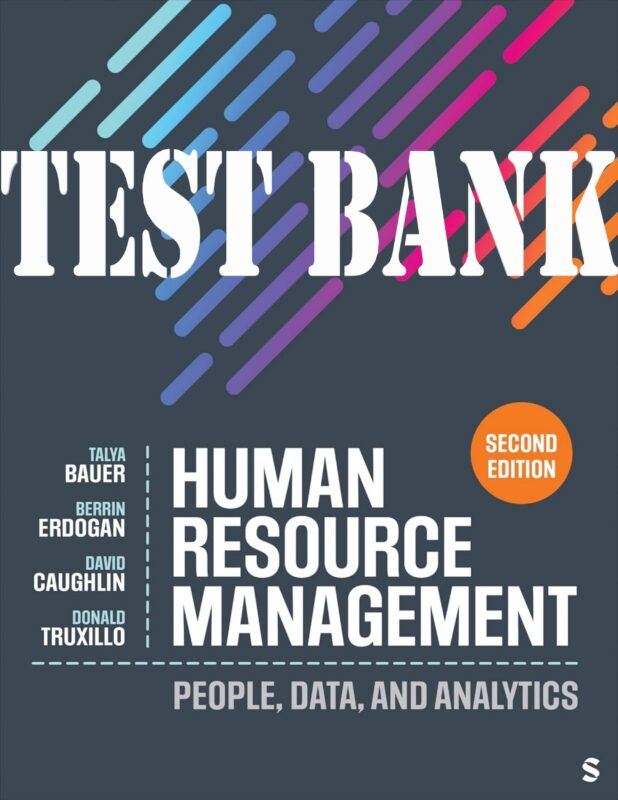
Test Bank for Human Resource Management People, Data, and Analytics 2nd Edition By Talya Bauer, Berrin Erdogan, David Caughlin
$39.00
Secure checkout
Instant digital download
PDF document
Document details
- Pages
- 235
- File size
- 516.15 KB
- Format
- Digital PDF
- Course
- Human Resource Management
- Category
- TEST BANKS
Sign in or create a free account to continue. Your purchase will be saved in My Downloads.
About this ebook
Test Bank for Human Resource Management: People, Data, and Analytics (2nd Edition) by Talya Bauer, Berrin Erdogan, David E. Caughlin, and Donald M. Truxillo provides an integrated look at talent management paired with data-driven decision-making. Rather than isolating analytics to a single section, workforce evaluation metrics and Society for Human Resource Management (SHRM) competencies are embedded natively into every functional topic across the text. [1, 2, 3]
The book is structured into 16 comprehensive chapters across 4 main parts: [1]
Part I: HRM in Context
-
- Chapter 1: Introduction to Human Resource Management — Foundations of HR, its evolving role, and how it delivers a competitive advantage through workforce talent. [1, 2]
- Chapter 2: Strategic HRM, Data-Informed Decision Making, and HR Analytics — Aligning HR goals with corporate strategy, utilizing descriptive, diagnostic, predictive, and prescriptive modeling. [1, 2]
- Chapter 3: Data Management and Human Resource Information Systems (HRIS) — Collecting, storing, and securing employee data; how HR software platforms manage reporting. [1, 2]
- Chapter 4: Diversity, Equity, and Inclusion (DEI), and Equal Employment Laws — Legal frameworks (such as EEOC), compliance, and best practices for creating inclusive workplaces. [1]
- Chapter 5: The Analysis and Design of Work — How jobs are structured, documenting workflow, and writing data-supported job descriptions. [1]
Part II: Managing the Talent Life Cycle
-
- Chapter 6: Workforce Planning and Recruitment — Forecasting labor demand and supply, tracking recruitment metrics, and modern sourcing channels.
- Chapter 7: Selection Processes and Procedures — Standardizing candidate assessments, validation of selection tools, and avoiding bias.
- Chapter 8: Training, Development, and Careers — Assessing training needs, designing employee development plans, and measuring return on investment (ROI).
- Chapter 9: Performance Management — Setting goals, delivering feedback, evaluation systems, and addressing underperformance.
- Chapter 10: Managing Employee Separations and Retention — Tracking employee turnover metrics, conducting exit interviews, and retention strategies. [1, 2]
Part III: Reward Systems
-
- Chapter 11: Developing a Pay Structure — Establishing market-competitive salary benchmarks and managing internal and external equity.
- Chapter 12: Rewarding Performance — Merit pay, incentive systems, bonuses, and variable compensation models.
- Chapter 13: Managing Benefits — Legally mandated benefits, health and retirement plans, and voluntary perks. [1]
Part IV: Special Topics in HR
- Chapter 14: Employee and Labor Relations — Workplace communication, resolving disputes, and working alongside collective bargaining/unions.
- Chapter 15: Employee Safety, Well-Being, and Wellness — OSHA compliance, mental health initiatives, and occupational safety metrics.
- Chapter 16: Opportunities and Challenges in International HRM — Managing talent globally, cross-border compliance, and expatriate management. [1]
File included
ScholarFriends.com-tb-ready.pdf
516.15 KB
Related ebooks