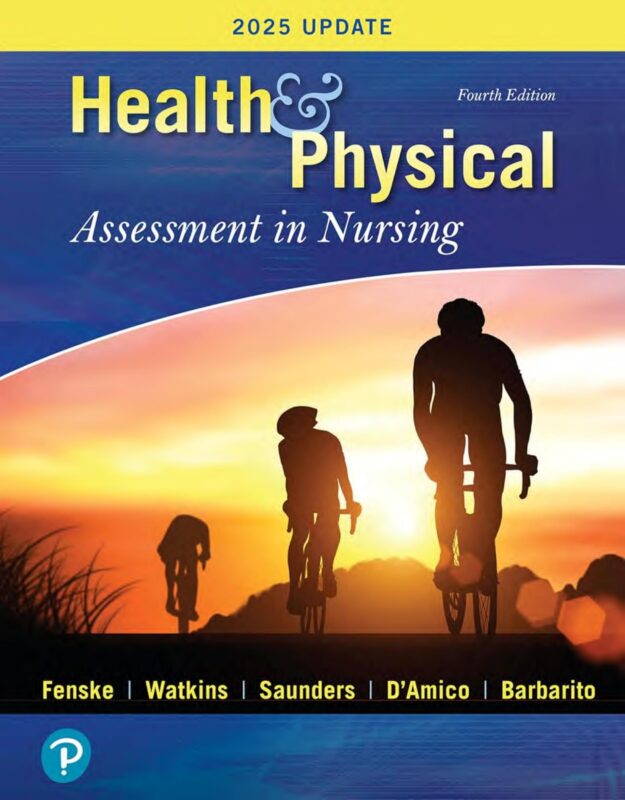
Health & Physical Assessment in Nursing 4th Edition By Cynthia Fenske, Katherine Dollan, WatkinsTina Saunders, Donita D’Amico, Colleen Barbarito
$30.00
Secure checkout
Instant digital download
PDF document
Document details
- Pages
- 822
- File size
- 35.33 MB
- Format
- Digital PDF
- Course
- Health Care
- Category
- eBook[PDF]
Sign in or create a free account to continue. Your purchase will be saved in My Downloads.
About this ebook
The textbook "Health & Physical Assessment in Nursing" (4th Edition) by Cynthia Fenske, Katherine Dollan Watkins, Tina Saunders, and Donita D'Amico provides comprehensive, holistic training for pre-licensure nursing students. It is structurally divided into four foundational units spanning 28 chapters, incorporating a strong emphasis on evidence-based practice, patient diversity, clinical reasoning, and documentation. [1, 2]
The detailed table of contents and topics covered include: [1]
Unit I: Foundations of Health Assessment
- Health Assessment Overview: The core role of health assessment in clinical RN practice.
- Health and Wellness: Evaluating holistic wellness models and preventative healthcare.
- Cultural and Spiritual Considerations: Tailoring communication and assessment to diverse patient beliefs.
- Health Disparities: Understanding systemic variations in patient healthcare access and outcomes. [1]
Unit II: Techniques for Health Assessment
- Interviewing and Health History: Methods for gathering accurate subjective data. [1]
- Documentation: Core principles for charting data (Featuring a new, dedicated chapter on best practices for distinguishing subjective vs. objective findings). [1]
- Physical Assessment Techniques and Equipment: Utilizing essential tools and the four pillars of assessment: inspection, palpation, percussion, and auscultation. [1, 2]
- General Survey and Physical Exam: Initial observations and gathering basic objective data. [1]
- Pain Assessment: Frameworks for quantifying and managing acute and chronic pain.
- Nutritional Assessment: Reviewing dietary habits, metabolic health, and body metrics.
- Psychosocial Health, Substance Use, and Violence Assessment: Screening protocols for mental health, addiction, and personal safety.
Unit III: Physical Assessment (Body Systems)
- Skin, Hair, and Nails: Integumentary evaluation and lesion identification.
- Head, Neck, and Related Lymphatics: Structural inspection and lymph node palpation.
- Eyes & Vision: Cranial nerve tracking, visual acuity, and external structure checks.
- Ears, Nose, Mouth, and Throat: Examining sensory organs and upper airway structures.
- Lungs and Thorax: Auscultating breath sounds and thoracic respiratory expansion.
- Breasts and Axillae: Tissue examinations, lymph pathways, and health screenings.
- Cardiovascular System: Heart sound auscultation (S1, S2, murmurs) and anatomical landmarks.
- Peripheral Vascular System: Pulse checks, capillary refill, and edema tracking.
- Abdomen: Altered system sequence (inspection, auscultation, percussion, palpation) to protect bowel sound accuracy.
- Male Genitourinary System: Reproductive health, prostate considerations, and anatomical screenings.
- Female Genitourinary System: Reproductive pathways, pelvic health, and screening practices.
- Musculoskeletal System: Range of motion (ROM), joint stability, and muscle strength.
- Neurologic System: Reflexes, cognitive status, motor function, and cranial nerve checks. [1, 2]
Unit IV: Specialized Assessment & Population Care
- The Pregnant Woman: Key structural and developmental anatomical shifts during gestation.
- Infants, Children, and Adolescents: Dedicated pediatric developmental milestones and tailored screening adaptations.
- The Older Adult: Assessing geriatric age-related changes, functional capacity, and cognitive updates.
- Complete Health Assessment: Integrating individual system assessments into a seamless, head-to-toe full exam. [1, 2, 3]
Appendices & Advanced Content
File included
tmpphpMT5gT4
35.33 MB
Related ebooks