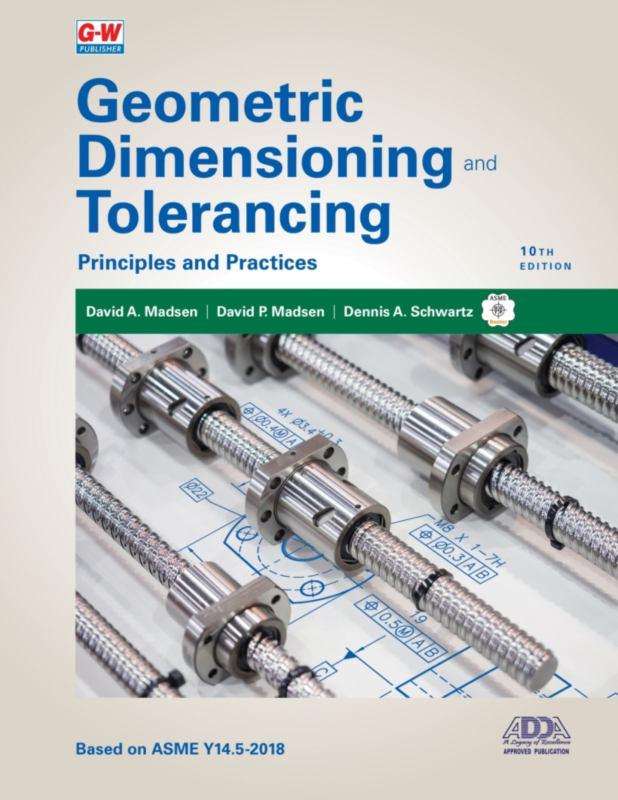
Geometric Dimensioning and Tolerancing: Principles and PracticesISBN-13 979-8897371969 10th Edition By David Madsen, David Madsen, Dennis Schwartz eBook EPUB PDF
$28.00
Secure checkout
Instant digital download
PDF document
Document details
- Pages
- 489
- File size
- 40.27 MB
- Format
- Digital PDF
- Course
- Education
- Category
- eBook[PDF]
Sign in or create a free account to continue. Your purchase will be saved in My Downloads.
About this ebook
Geometric Dimensioning and Tolerancing: Principles and Practices (10th Edition), authored by David A. Madsen, David P. Madsen, and Dennis A. Schwartz, provides complete coverage of GD&T practices aligned with the ASME Y14.5–2018 standard. [1, 2]
The book is structurally organized in a methodical sequence to build user expertise from foundational concepts to advanced mechanical applications. [1]
Core Table of Contents
The textbook is divided into the following primary chapters and sections: [1]
- Chapter 1: Geometric Dimensioning and Tolerancing Essentials — Introduces GD&T concepts, manufacturing lifecycle benefits, and industrial design applications.
- Chapter 2: Dimensioning and Tolerancing Practices — Covers baseline tolerancing methods, fundamental coordinate systems, and general dimension limits.
- Chapter 3: Introduction to Symbols and Terms — Deep-dives into the symbolic language, feature control frames, and proper representation on drawings.
- Chapter 4: Datums — Covers establishing datum reference frames, target points, and primary, secondary, and tertiary constraints.
- Chapter 5: Material Condition and Material Boundary — Explains Maximum Material Condition (MMC), Least Material Condition (LMC), and Regardless of Feature Size (RFS).
- Chapter 6: Form Tolerances — Focuses on non-datum geometric controls including flatness, straightness, circularity, and cylindricity.
- Chapter 7: Orientation Tolerances — Details angularity, perpendicularity, and parallelism controls.
- Chapter 8: Positional Tolerances (Part I) — Introduces location controls for features of size.
- Chapter 9: Positional Tolerances (Part II) and Virtual Condition — Advanced positional calculation strategies and mating parts requirements.
- Chapter 10: Profile Tolerances — Analyzes profile of a line and profile of a surface controls.
- Chapter 11: Runout Tolerances — Addresses circular runout and total runout variations. [1, 2, 3, 4]
Supplementary Practical Sections
To reinforce concepts and provide real-world training, the back of the book includes dedicated practical application resources: [1, 2]
- Drafting Problems — Real-world design and annotation exercises.
- Prints for Print Reading Problems — Industry-standard sample drawings to hone blueprint interpretation skills.
- Appendix A & B — Complete definitions of symbols specifications and necessary mathematical reference materials. [1]
File included
Geometric-Diminsioning-Tolerancing-10th-Edition-By-David-Madsen-David-Madsen-Dennis-Schwartz-eBook-EPUB-PDF.pdf
40.27 MB
Related ebooks