Test Bank for General, Organic, and Biological Chemistry, 4th Edition by Laura Frost & Todd Deal
$24.00
Secure checkout
Instant digital download
PDF document
Document details
- Pages
- 359
- File size
- 3.85 MB
- Format
- Digital PDF
- Course
- Chemistry
- Category
- TEST BANKS
Sign in or create a free account to continue. Your purchase will be saved in My Downloads.
About this ebook
Test Bank for General, Organic, and Biological Chemistry, 4E, 4th Edition by Laura D. Frost,S. Todd Deal TEST BANK
ISBN-13: 9780135765944
Full chapters included
1. Chemistry Basics - Matter and Measurement
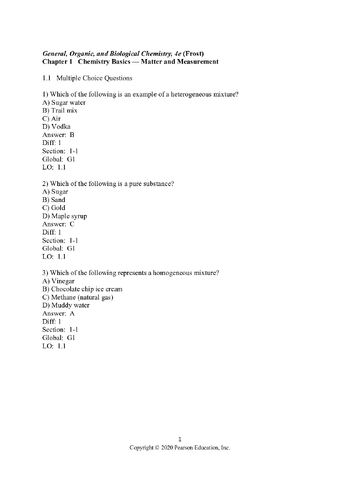
1.1 Classifying Matter: Pure Substance or Mixture
1.2 Elements, Compounds, and Periodic Table
1.3 How matter Changes
1.4 Math Counts
1.5 Matter: The "Stuff" of Chemistry
1.6 Measuring Matter
2. Atoms and Radioactivity
2.1 Atoms and Their Components
2.2 Atomic Number and Mass Number
2.3 Isotopes and Atomic Mass
2.4 Radioactivity and Radioisotopes
2.5 Nuclear Equations and Radioactive Decay
2.6 Radiation Units and Half-Lives
2.7 Medical Applications for Radioisotopes
3. Compounds - How Elements Combine
3.1 Electron Arrangements and the Octet Rule
3.2 In Search of an Octet, Part 1: Ion Formation
3.3 Ionic Compounds- Electron Give and Take
3.4 In Search of an Octet, Part 2: Covalent Bond Formation
3.5 The Mole: Counting Atoms and Compounds
3.6 Getting Covalent Compounds into Shape
3.7 Electronegativity and Molecular Polarity
4. Introduction to Organic Compounds
4.1 Representing the Structures of Organic Compounds
4.2 Alkanes: The Simplest Organic Compounds
4.3 Families of Organic Compounds- Functional Groups
4.4 Nomenclature of Simple Alkanes
4.5 Isomerism in Organic Compounds
5. Chemical Reactions
5.1 Thermodynamics
5.2 Chemical Reactions: Kinetics
5.3 Overview of Chemical Reactions
5.4 Oxidation and Reduction
5.5 Organic Reactions: Condensation and Hydrolysis
5.6 Organic Addition Reactions to Alkenes
6. Carbohydrates - Life's Sweet Molecules
6.1 Classes of Carbohydrates
6.2 Function Groups in Monosaccharides
6.3 Stereochemistry in Monosaccharides
6.4 Reactions of Monosaccharides
6.5 Disaccharides
6.6 Polysaccharides
6.7 Carbohydrates and Blood
7. States of Matter and Their Attractive Forces: Gas Laws, Solubility, and Applications to the Cell Membrane
7.1 Gases and Gas Laws
7.2 Liquids and Solids: Predicting Properties Through Attractive Forces
7.3 Attractive Forces and Solubility
7.4 Dietary Lipids
7.5 Attractive Forces and the Cell Membrane
8. Solution Chemistry - Sugar and Water Do Mix
8.1 Solutions Are Mixtures
8.2 Formation of Solutions
8.3 Chemical Equations for Solution Formation
8.4 Concentration
8.5 Dilution
8.6 Osmosis and Diffusion
8.7 Transport Across
9. Acids, Bases, and Buffers in the Body
9.1 Acids and Bases- Definitions
9.2 Strong Acids and Bases
9.3 Chemical Equilibrium
9.4 Weak Acids and Bases
9.5 pH and the pH Scale
9.6 pKa
9.7 The Relationship Between pH, pKa, Drug Solubility, and Diffusion
9.8 Buffers and Blood- The Bicarbonate Buffer System
10. Proteins - Workers of the Cell
10.1 Amino Acids- The Building Blocks
10.2 Protein Formation
10.3 The Three-Dimensional Structure of Proteins
10.4 Denaturation of Proteins
10.5 Protein Functions
10.6 Enzymes - Life’s Catalysts
10.7 Factors That Affect Enzyme Activity
11. Nucleic Acids - Big Molecules with a Big Role
11.1 Components of Nucleic Acids
11.2 Nucleic Acid Formation
11.3 DNA
11.4 RNA and Protein Synthesis
11.5 Putting It Together: The Genetic Code and Protein Synthesis
11.6 Genetic Mutations
11.7 Viruses
11.8 Recombinant DNA Technology
12. Food as Fuel - An Overview of Metabolism
12.1 How Metabolism Works
12.2 Metabolically Relevant Nucleotides
12.3 Digestion - From Food Molecules to Hydrolysis Products
12.4 Glycolysis - From Hydrolysis Production to Common Metabolites
12.5 The Citric Acid Cycle - Central Processing
12.6 Electron Transport and Oxidative Phosphorylation
12.7 ATP Production
12.8 Other Fuel Choices
File included
Frost-4e-Test-Bank.pdf
3.85 MB
Related ebooks