
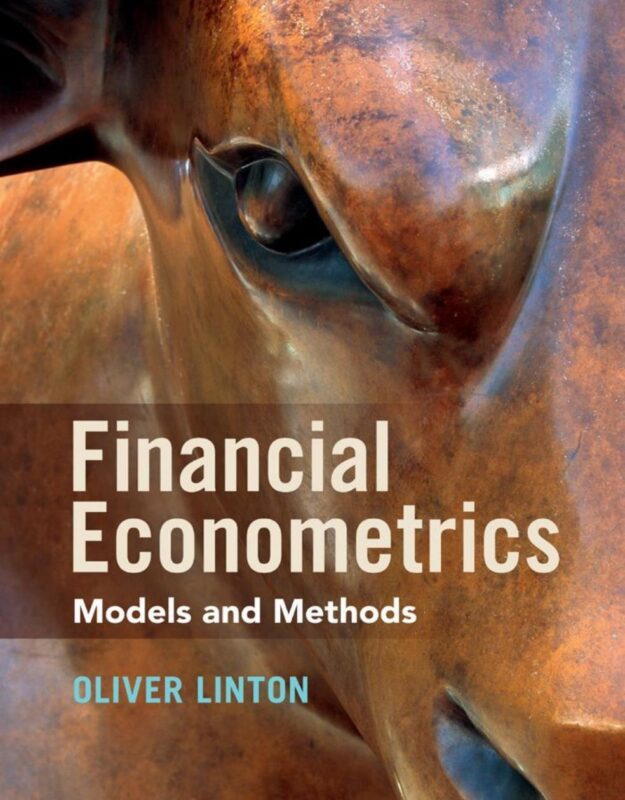
Financial Econometrics Models and Methods By Oliver Linton
$27.00
Secure checkout
Instant digital download
PDF document
Document details
- Pages
- 557
- File size
- 24.58 MB
- Format
- Digital PDF
- Course
- Education
- Category
- eBook[PDF]
Sign in or create a free account to continue. Your purchase will be saved in My Downloads.
About this ebook
The book Financial Econometrics: Models and Methods by Oliver Linton provides a thorough exploration of modern financial econometrics, bridging theoretical principles with real-world applications. It covers major developments in empirical finance over the past two decades, extending the core frameworks originally popularised in standard texts. [1, 2, 3]
The textbook is sequentially organised into the following core topics: [1]
🗒 Main Course Topics
- Introduction and background – Contextual framework of financial markets and quantitative research foundations.
- Econometric background – Review of the statistical and econometric foundations needed for modern financial time series analysis.
- Return predictability and the efficient markets hypothesis – Core concepts testing whether asset returns can be predicted using historical prices.
- Robust tests and tests of nonlinear predictability of returns – Advanced techniques handling non-standard distributions and complex, non-linear relationships in market data.
- Empirical market microstructure – Analysis of order flows, trading mechanisms, bid-ask spreads, and transaction costs.
- Event study analysis – Methodology tracking how specific corporate or economic events impact asset prices.
- Portfolio choice and testing the capital asset pricing model (CAPM) – Statistical evaluation of the CAPM framework and mean-variance portfolio optimisation.
- Multifactor pricing models – Econometric frameworks for structural factor designs, including Arbitrage Pricing Theory (APT) and empirical multi-factor models.
- Present value relations – Mathematical and statistical tracking of stock prices, corporate dividends, and discount rate dynamics.
- Intertemporal equilibrium pricing – Advanced asset pricing models that simulate consumer choice, risk aversion, and consumption patterns across time.
- Volatility – In-depth measurement and modelling of financial volatility, featuring ARCH, GARCH, and stochastic volatility frameworks.
- Continuous time processes – Mathematical models underlying derivative pricing, continuous asset paths, and Brownian motion.
- Yield curve – Econometric modeling of fixed-income security pricing, interest rate term structures, and bond dynamics.
- Risk management and tail estimation – Statistical analysis focusing on extreme market events, Value at Risk (VaR), and Expected Shortfall (ES). [1, 2, 3, 4, 5]
📊 Practical and Review Sections
File included
tmpphpC8oXWZ
24.58 MB
Related ebooks