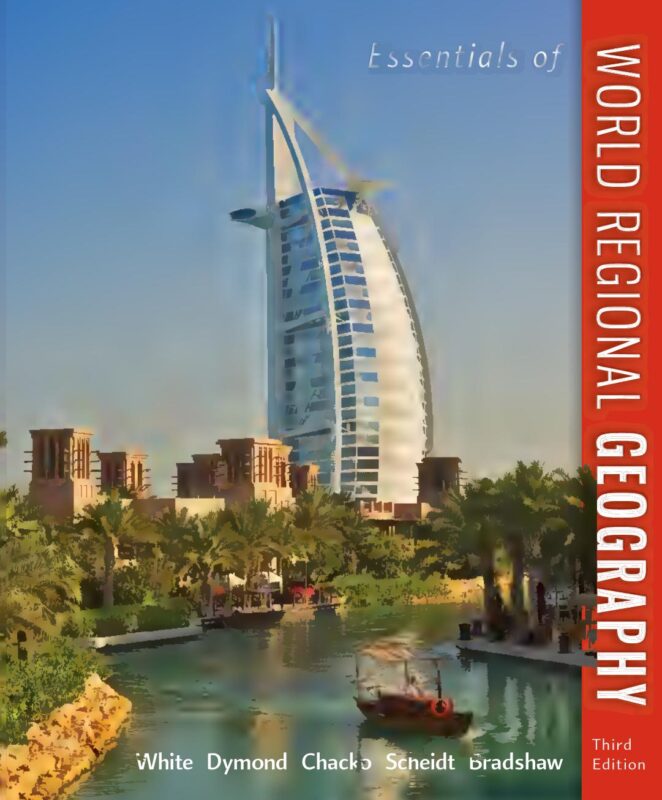
Essentials of World Regional Geography 3rd Edition By White, George
$30.00
Secure checkout
Instant digital download
PDF document
Document details
- Pages
- 409
- File size
- 942.81 KB
- Format
- Digital PDF
- Course
- Geography
- Category
- eBook[PDF]
Sign in or create a free account to continue. Your purchase will be saved in My Downloads.
About this ebook
Essentials of World Regional Geography (3rd Edition) by George W. White, Joseph Dymond, Elizabeth Chacko, and Michael Bradshaw is structured around nine regional chapters alongside an introductory framework. The textbook utilizes a distinct three-section breakdown for each region to explore physical landscapes, internal cultural differences, and modern global challenges. [1, 2, 3]
The specific chapters and underlying themes covered in the text include the following:
Core Geographic Chapters
According to the textbook's structure, the world is broken down into these primary operational units: [1]
- Essentials of World Regional Geography: An introductory overview of core global concepts.
- Europe: Focuses on the European subcontinent, its economic integration, and cultural landscapes.
- Russia and Neighboring Countries: Examines the vast Eurasian landmass, post-Soviet transitions, and geopolitical dynamics.
- East Asia: Covers economic powerhouses like China, Japan, and South Korea, alongside their rapid urbanization.
- Southeast Asia: Investigates the archipelagoes, tropical environments, and diverse religious impacts of the region.
- South Asia: Centers heavily on the Indian subcontinent, population pressures, and monsoon dynamics.
- Northern Africa and Southwestern Asia: Analyzes the Middle East and North Africa, focusing on arid climates, oil politics, and cultural history.
- Africa South of the Sahara: Details sub-Saharan resource management, developmental challenges, and rich cultural diversity.
- The Americas & Oceania: Explores North America, Latin (Middle/South) America, and the Pacific realm. [1, 2]
Standardized 3-Section Framework Per Region
To ensure easy comparison across different environments, every regional chapter follows an identical structure: [1]
- Section 1: Physical and Human Geographies: Summarizes the region's climate zones, tectonic settings, terrain features, population trends, and overarching cultural origins. [1]
- Section 2: Internal Diversity: Drills down into localized variations at sub-regional, country-specific, and city levels. [1]
- Section 3: Contemporary Global Issues: Spotlights highly debated topics impacting the region today, presented in a debate format to build analytical skills. [1, 2]
Interdisciplinary Themes Addressed Throughout
Beyond regional breakdowns, the text integrates cross-cutting topics crucial to modern global citizenship: [1]
- Environmental Systems: Focuses on climate change, deforestation patterns, and the human impact on fragile natural resources.
- Global Economics: Covers core-periphery dynamics, trade alliances, and shifting patterns in the global economy.
- Demographics & Geopolitics: Explores shifting population pyramids, intense rural-to-urban migration, territorial disputes, and border conflicts.
- Cultural Landscapes: Evaluates language distribution, major world religions, and gender (in)equality across distinct geographic areas. [1, 2, 3]
File included
tmpphpgYQ95p
942.81 KB
Related ebooks