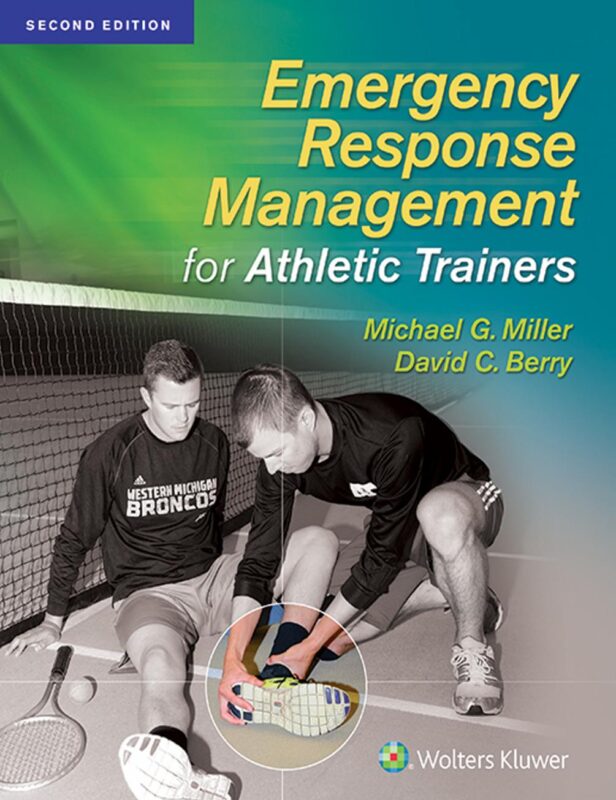
Emergency Response Management for Athletic Trainers 2nd Edition By Michael Miller, David Berry
$30.00
Secure checkout
Instant digital download
PDF document
Document details
- Pages
- 560
- File size
- 4.03 MB
- Format
- Digital PDF
- Course
- Management
- Category
- eBook[PDF]
Sign in or create a free account to continue. Your purchase will be saved in My Downloads.
About this ebook
Emergency Response Management for Athletic Trainers (2nd Edition), by Michael Miller and David Berry, targets the specific cognitive and psychomotor skills required for managing urgent medical situations in sports environments. It bridges traditional first-aid protocols (such as EMT, first responder, and professional CPR) with the specific Board of Certification (BOC) and National Athletic Trainers' Association (NATA) emergency trauma competencies. [1, 2]
The primary subject areas and topics covered in this edition include:
🆕 Core Second Edition Enhancements
- Team Physician Collaboration: An entirely new chapter dedicated to communication, logistics, and integrating workflows with Team Physicians during acute emergencies. [1]
- Advanced Concussion Management: Expanded protocols detailing the immediate assessment, tracking, and management of sports-related concussions. [1]
- Integrated Visual Learning: Digital video modules demonstrating real-time psychomotor skills like bagging, primary assessments, and equipment removal. [1, 2]
1. Foundations of Emergency Action & Preparation
- Emergency Action Plans (EAPs): Developing, implementing, and annual rehearsing of institutional emergency strategies.
- EMS Integration: Coordinating communication, venue directions, and seamless care handoffs with local emergency medical services.
- Legal & Ethical Considerations: Risk management, documentation requirements, and liability protection for the athletic trainer.
- Bloodborne Pathogens & Infection Control: Utilizing Personal Protective Equipment (PPE), universal precautions, and managing sterile or clean environments during trauma care. [1, 2, 3]
2. Physical & Diagnostic Assessment
- Primary Assessment: Initial scene survey, checking for consciousness, and immediate life-threat identification.
- Secondary Assessment: Systematic head-to-toe physical evaluation, vital signs tracking, and rapid trauma checks.
- Ongoing Monitoring: Methods for re-evaluating unstable patients while awaiting transport. [1]
3. Cardiorespiratory and Airway Management
- Respiratory & Circulatory Arrest: High-performance CPR techniques tailored for professional rescuers.
- Advanced Airway Management: Clearing obstructions, utilizing adjuncts (OPA/NPA), and bag-valve-mask (BVM) ventilation techniques.
- Supplemental Oxygen Administration: Competencies for delivering oxygen using devices like nasal cannulas and non-rebreather masks.
- Automated External Defibrillation (AED): Cardiac arrest management, electrode placement variations, and special environmental considerations. [1, 2, 4, 5]
4. Traumatic Injuries & Orthopedic Stabilization
- Spinal Motion Restriction (SMR): Spine boarding, cervical spine immobilization, and handling sport-specific equipment (e.g., football helmets and shoulder pads).
- Splinting & Immobilization: Applying rigid, vacuum, and traction splints to fractures and dislocations.
- Acute Skin & Soft Tissue Trauma: Wound debridement, hemorrhage control via direct pressure/tourniquets, and sterile dressing management. [1]
5. Sudden Medical Illnesses & Environmental Conditions
- Exertional Heat Illnesses: Assessment and treatment protocols for heat exhaustion, heat stroke, and cold-related medical emergencies.
- Systemic Medical Conditions: Emergency response for diabetic shock, acute asthma attacks, anaphylaxis, and sudden cardiac event triggers. [1]
File included
tmpphpO9inhI
4.03 MB
Related ebooks