
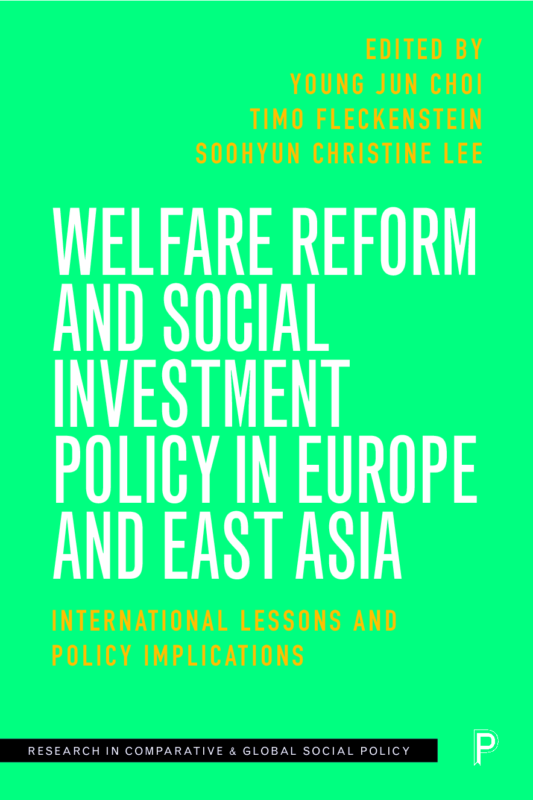
Welfare Reform and Social Investment Policy in Europe and By Young Jun Choi, Timo Fleckenstein, Soohyun
$30.00
Secure checkout
Instant digital download
PDF document
Document details
- Pages
- 384
- File size
- 2.93 MB
- Format
- Digital PDF
- Course
- Social Sciences
- Category
- eBook[PDF]
Sign in or create a free account to continue. Your purchase will be saved in My Downloads.
About this ebook
The book Welfare Reform and Social Investment Policy in Europe and East Asia: International Lessons and Policy Implications, co-edited by Young Jun Choi, Timo Fleckenstein, and Soohyun Christine Lee, covers a comprehensive range of topics focused on how countries transition from compensatory welfare systems to proactive social investment strategies. Published by Bristol University Press, the volume utilizes a life course perspective to evaluate policies across labour markets, education, and family structures. [1, 2]
Core Analytical Themes
- Life Course Perspective: Analyzing policy impacts across different phases of life, spanning early childhood to old age.
- Public vs. Private Investment: Investigating how states balance public social funding with private contributions.
- Cross-Regional Analysis: Comparing Western European developments (e.g., Germany, England, Italy, Spain) with East Asian models (e.g., South Korea, Japan).
- Inequality and Mobility: Examining if social investments reduce societal divides or unintentionally widen them. [1, 2, 3, 4, 5]
Specific Chapter Topics Covered
According to the book's breakdown on Cambridge University Press and Bristol University Press Digital, the core chapters cover the following practical topics: [1, 2]
- Work–Family Policy Expansion: How countries like Germany, England, South Korea, and Japan integrate social investment into parental leave and childcare. [1, 2]
- Shadow and Private Education: The rise of private education markets, specifically evaluating the impact of South Korea's "shadow education" on academic and labour outcomes. [1, 2]
- Higher Education and Employability: The role of advanced schooling in building a workforce prepared for a modern knowledge-based economy. [1, 2]
- Labour Market Flow and Institutional Complementarities: Assessing how family support policies interact with job market conditions in Italy, Spain, Japan, and South Korea. [1]
- Gender and Household Dynamics: The relationship between broader social investment trends and the traditional division of housework. [1]
- Latecomer Challenges and Human Capital: Measuring economic outcomes and capital depreciation rates in countries implementing these policies later than Western counterparts. [1]
- Active Ageing and Care Networks: The shifting roles of grandparenting and the governance of long-term elder care systems. [1]
File included
tmpphpuD3pzf
2.93 MB
Related ebooks