
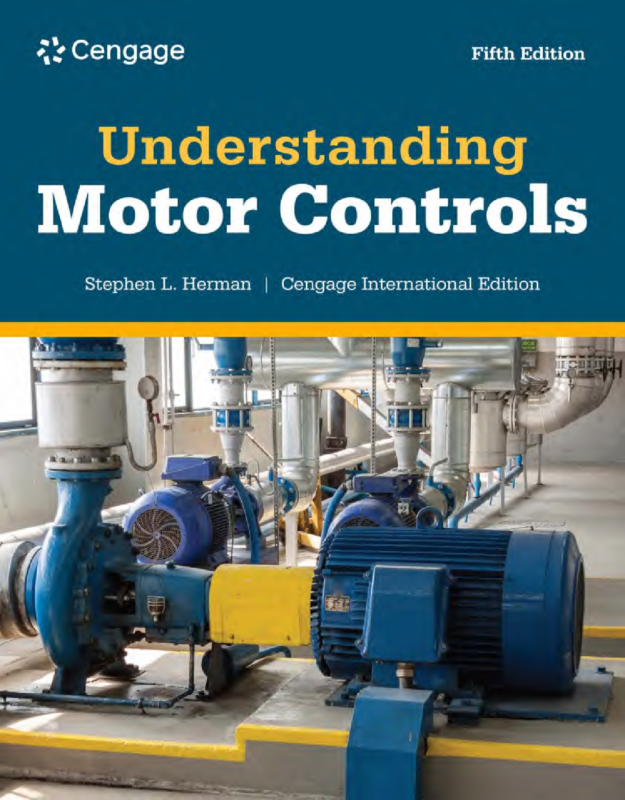
Understanding Motor Controls 5th Edition By Stephen Herman, Frank Seiler
$30.00
Secure checkout
Instant digital download
PDF document
Document details
- Pages
- 690
- File size
- 11.77 MB
- Format
- Digital PDF
- Course
- Education
- Category
- eBook[PDF]
Sign in or create a free account to continue. Your purchase will be saved in My Downloads.
About this ebook
Understanding Motor Controls, 5th Edition by Stephen Herman and Frank Seiler covers fundamental to advanced motor control components, circuit design, troubleshooting, and code compliance. The textbook is structured specifically for students or technicians with no prior experience in the field. [1]
The comprehensive breakdown of the core topics and practical concepts covered across its sections includes:
Core Concepts & Circuit Fundamentals
- Basic Principles: Introduction to the foundational physics and electrical theories governing motor operations.
- Schematic & Wiring Diagrams: Methods for drawing, reading, and interpreting ladder logic and control circuit schematics.
- Building Circuits: Practical step-by-step guidance on constructing simple control loop circuits from scratch. [1, 2, 3, 4, 5]
Control Components & Devices
- Motor Starters: Across-the-line starting mechanisms and reduced-voltage methods.
- Timing Relays: Deep dive into legacy and modern electronic timing relays used to delay circuit operations.
- Control Sensors: Implementation of limit switches, pressure switches, float switches, and proximity sensors.
- Overload Protection: Clear instructions on selecting overload sizes and heater components to safely protect control circuitry. [1, 2, 3, 4, 5]
Advanced System Controllers
- Auto-Transformer Starters: Operating principles and wiring setups for reduced-voltage auto-transformer motor starters.
- Electronic & Programmable Devices: Introduction to Variable Frequency Drives (VFDs), solid-state controllers, and Programmable Logic Controllers (PLCs).
- Legacy vs. Modern Equipment: Comparison of older analog control setups alongside state-of-the-art automated systems. [1, 2, 3, 4]
Practical Field Operations
- Troubleshooting Skills: Diagnostic techniques utilizing basic multi-meters and specialized test equipment to isolate circuit faults. [1]
- NEC Compliance: Application of the latest National Electrical Code (NEC) rules regarding safe motor installation, conductor sizing, and short-circuit protection. [1, 2]
- Laboratory Experiments: Built-in, hands-on lab exercises that systematically transition from simple control circuits to complex automated systems. [1]
File included
tmpphpQnMqsC
11.77 MB
Related ebooks