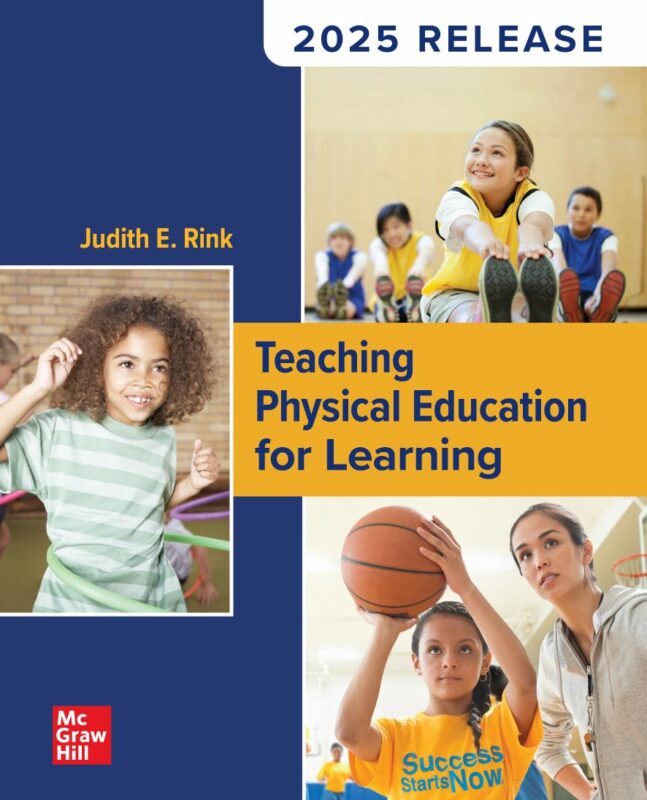
Teaching Physical Education for Learning 2025 Release By Judith E. Rink
$30.00
Secure checkout
Instant digital download
PDF document
Document details
- Pages
- 382
- File size
- 18.61 MB
- Format
- Digital PDF
- Course
- Education
- Category
- eBook[PDF]
Sign in or create a free account to continue. Your purchase will be saved in My Downloads.
About this ebook
Teaching Physical Education for Learning: 2025 Release by Judith E. Rink covers foundational and advanced methodologies for training K-12 physical education teachers. The textbook focuses on designing effective learning experiences, developing student motor skills, and adapting to diverse student needs. [1, 2]
The core curriculum is divided into specific chapters and thematic areas: [1]
The Teaching-Learning Process
- Orientation to Physical Education: Understanding teaching as a goal-oriented activity and managing routines.
- Factors Influencing Learning: Exploring how motor skill competence directly impacts a student's lifelong physical activity.
- Designing Instructional Tasks: Structuring movement tasks and learning experiences for maximum student engagement.
- Task Presentation: Effectively communicating and demonstrating instructional content to students.
- Content Analysis: Developing curriculum materials and tailoring physical activities to grade-appropriate benchmarks. [1, 2, 3, 4, 5]
Instructional Strategies & Classroom Management
- Learning Environments: Strategies for building, organizing, and maintaining a safe and productive movement environment.
- Teacher Behavior During Activity: Managing student behavior and monitoring performance in real-time during physical tasks.
- Interactive Teaching Strategies: Deploying diverse instructional models to motivate students and foster inclusion.
- Student Motivation & Growth: Cultivating personal accountability, positive peer interaction, and inclusion in sports. [1, 2, 3, 4]
Planning, Assessment, & Professional Practice
- Lesson & Unit Planning: Designing cohesive long-term curriculums that align with national standards.
- Instructional Assessment: Implementing formative and summative metrics, including peer reviews and skill check-ins.
- Content-Specific Pedagogy: Adapting general instructional models to distinct athletic categories like dance, gymnastics, or team sports.
- Continuous Teacher Learning: Self-reflection, observing behavior, and adapting teaching styles over time. [1, 2, 3, 4]
File included
tmpphpJK1Z7X
18.61 MB
Related ebooks