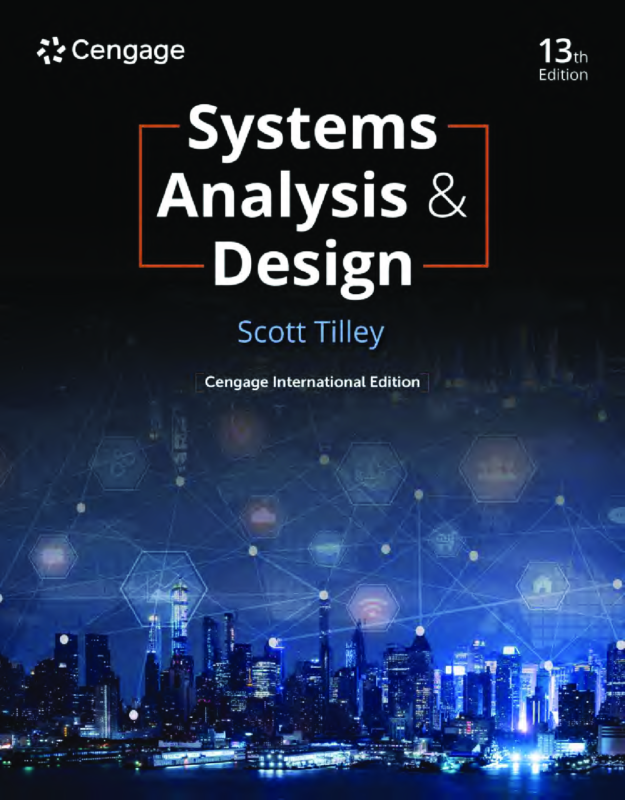
Systems Analysis and Design 13th Edition By Scott Tilley
$30.00
Secure checkout
Instant digital download
PDF document
Document details
- Pages
- 626
- File size
- 12.03 MB
- Format
- Digital PDF
- Category
- eBook[PDF]
Sign in or create a free account to continue. Your purchase will be saved in My Downloads.
About this ebook
The 13th Edition of Systems Analysis and Design by Scott Tilley is structured around the five key phases of the Systems Development Life Cycle (SDLC). It features contemporary updates on emerging technologies like Artificial Intelligence (AI), Machine Learning (ML), Cloud Computing, Blockchain, and Cybersecurity. [1, 2, 3]
Phase I: Planning
- Chapter 1: Introduction to Systems Analysis & Design – Foundational concepts of information systems, development methodologies, and the role of the systems analyst. [1, 2]
- Chapter 2: Analyzing the Business Case – Evaluating strategic planning, feasibility studies (economic, technical, operational), and business profiles. [1, 2, 3]
- Chapter 3: Managing Systems Projects – Project planning, scheduling tools (PERT/CPM, Gantt charts), risk management, and team leadership. [1, 2]
Phase II: Analysis
- Chapter 4: Requirements Engineering – Fact-finding techniques, user story documentation, and defining functional and non-functional requirements. [1, 2, 3, 4]
- Chapter 5: Data & Process Modeling – Creating Data Flow Diagrams (DFDs), data dictionaries, and process descriptions. [1, 2, 3, 4]
- Chapter 6: Object Modeling – Object-oriented analysis concepts using the Unified Modeling Language (UML), including use case and class diagrams. [1, 2, 3]
Phase III: Design
- Chapter 7: User Interface Design – Human-computer interaction (HCI) principles, input/output controls, and user-centric design.
- Chapter 8: Data Design – Relational database design, data structures, normalization, and data storage architectures.
- Chapter 9: System Architecture – Network models, enterprise resource planning (ERP), and cloud-based architecture scaling. [1, 2, 3, 4]
Phase IV: Implementation
- Chapter 10: Development Strategies – Comparing software acquisition options, software as a service (SaaS), and custom development vs. commercial software. [1, 2]
- Chapter 11: Managing Systems Implementation – Quality assurance, application development paradigms, software engineering (cohesion/coupling), testing, and training. [1, 2]
Phase V: Deployment & Operations
- Chapter 12: Maintenance & Support – Post-implementation strategies, type of maintenance, user assistance, and configuration management.
- Chapter 13: Managing Systems Security – Comprehensive security controls, risk assessment, data encryption, and cyber threat mitigation. [1, 2, 3, 4, 5]
Specialized Appendices
- Appendix A: Communications – Professional presentation skills, technical report writing, and cross-team communication strategies.
- Appendix B: Finance – Financial analysis tools, calculation of return on investment (ROI), payback analysis, and net present value (NPV). [1, 2]
File included
tmpphppbmMjN
12.03 MB
Related ebooks