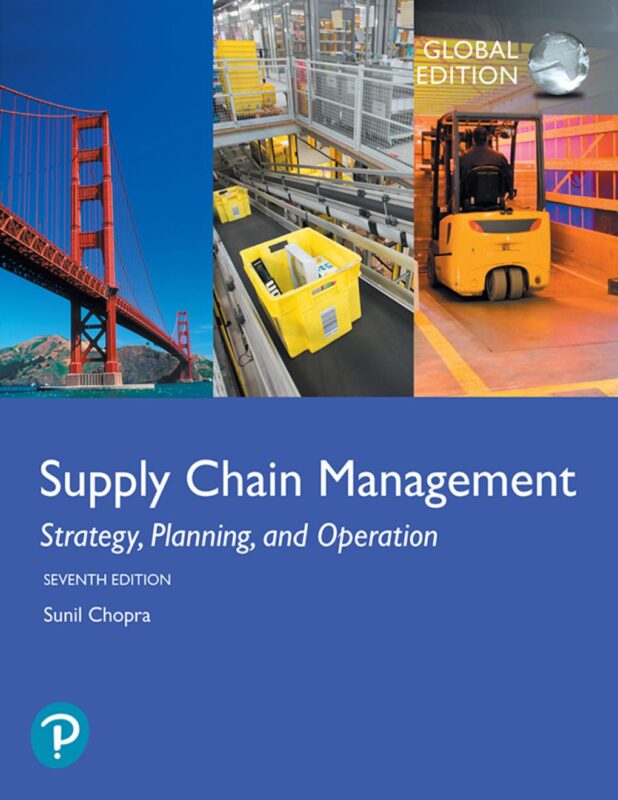
Supply Chain Management: Strategy, Planning, and Operation 7th Global Edition By Sunil Chopra
$28.00
Secure checkout
Instant digital download
PDF document
Document details
- Pages
- 1,326
- File size
- 21.83 MB
- Format
- Digital PDF
- Course
- Supply Chain Management
- Category
- eBook[PDF]
Sign in or create a free account to continue. Your purchase will be saved in My Downloads.
About this ebook
The 7th Global Edition of Supply Chain Management: Strategy, Planning, and Operation by Sunil Chopra is structured around six core parts that establish a strategic framework for understanding logistics, network design, and operational excellence. [1, 2]
The complete breakdown of the chapters and topics covered in the Pearson official curriculum is structured as follows: [1]
Part I: Building a Strategic Framework to Analyze Supply Chains
This section establishes the fundamental concepts and the direct link between supply chain choices and financial performance. [1, 2]
- Understanding the Supply Chain: Definitions, stages, and the flow of information, products, and funds.
- Supply Chain Performance: Achieving strategic fit and expanding the scope of strategic alignment across partners.
- Supply Chain Drivers and Metrics: Detailed exploration of facilities, inventory, transportation, information, sourcing, and pricing. [1, 2, 3, 4, 5]
Part II: Designing the Supply Chain Network
- Designing Distribution Networks: Structural options with practical applications to online and omni-channel retailing.
- Network Design in the Supply Chain: Mathematical and conceptual models for allocating facility locations and capacity.
- Designing Global Supply Chain Networks: Managing risk, uncertainty, and flexibility in international operations. [1, 2, 3, 4]
Part III: Planning and Coordinating Demand and Supply
- Demand Forecasting in a Supply Chain: Time-series techniques, forecasting errors, and collaborative planning.
- Aggregate Planning: Optimizing production levels, staffing, and subcontracting over a medium horizon.
- Sales and Operations Planning (S&OP): Managing predictable variability and balancing supply with demand.
- Coordination in a Supply Chain: Mitigating the bullwhip effect and enhancing visibility across partners. [1, 2]
Part IV: Planning and Managing Inventories
This section introduces the quantitative models needed to balance availability against holding costs. [1, 2]
- Cycle Inventory: Managing economies of scale through lot sizing and Economic Order Quantity (EOQ) models.
- Safety Inventory: Managing demand and supply uncertainty to optimize product service levels.
- Optimal Level of Product Availability: Linking fulfillment rates directly to bottom-line corporate profits. [1, 2]
Part V: Designing and Planning Transportation Networks
- Transportation in a Supply Chain: Modes of transit, network design options, and balancing cost against responsiveness. [1]
Part VI: Managing Cross-Functional Drivers
The final core segment covers systemic themes that require integration across all corporate functions. [1, 2]
- Sourcing Decisions: Outsourcing strategies, supplier selection, and procurement contracts.
- Pricing and Revenue Management: Utilizing dynamic pricing and segments to maximize yield from assets.
- Sustainability and the Supply Chain: Integrating green practices, recycling, and social compliance into core operations. [1, 2, 3]
File included
tmpphplOsaWA
21.83 MB
Related ebooks