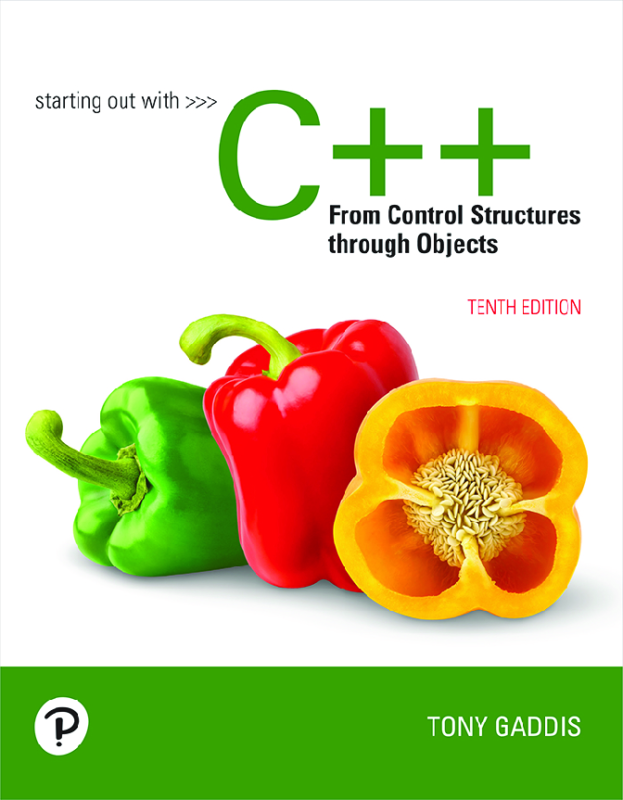
eBook Starting out with C++ From Control Structures through Objects 10th Edition By Tony Gaddis
$30.00
Secure checkout
Instant digital download
PDF document
Document details
- Pages
- 1,397
- File size
- 9.9 MB
- Format
- Digital PDF
- Course
- ATI - RN Nutrition
- Category
- eBook[PDF]
Sign in or create a free account to continue. Your purchase will be saved in My Downloads.
About this ebook
The Starting Out with C++: From Control Structures through Objects (10th Edition)" by Tony Gaddis introduces core programming fundamentals before transitioning into intermediate and advanced object-oriented programming concepts. It covers modern C++ features up to C++17, with select introductions to C++20 (such as tuples, lambdas, and initialization syntax inside
if statements). [1, 2, 3]The textbook is structurally organized into the following chapters: [1]
1. Fundamental Programming Concepts
- Chapter 1: Introduction to Computers and Programming – Hardware, software, the programming process, and procedural vs. object-oriented logic. [1, 2]
- Chapter 2: Introduction to C++ – Basic syntax, data types, variables, string literals, identifiers, and simple console output. [1, 2]
- Chapter 3: Expressions and Interactivity – Reading keyboard input (
cin), mathematical expressions, type conversion, and formatted output. - Chapter 4: Making Decisions – Relational operators,
if,if/else, nested decisions, logical operators, andswitchstatements. [1] - Chapter 5: Loops and Files – Increment/decrement operators,
while,do-while, andforloops, along with basic file input/output (reading and writing text files).
2. Functions, Arrays, and Pointers
- Chapter 6: Functions – Defining and calling modular functions, passing arguments by value/reference, overloaded functions, and default arguments.
- Chapter 7: Arrays and Vectors – Memory allocation for lists, processing array contents, multi-dimensional arrays, and using the
std::vectorclass. - Chapter 8: Searching and Sorting Arrays – Common algorithms like Linear Search, Binary Search, Bubble Sort, and Selection Sort.
- Chapter 9: Pointers – Pointer variables, memory addresses, pointer arithmetic, dynamically allocating memory, and raw array relationships.
3. Data Structures and Strings
- Chapter 10: Characters, C-Strings, and More about the string Class – Character testing, legacy C-strings, tokenization, and advanced usage of standard string objects.
- Chapter 11: Structured Data – Creating custom composite data structures (
struct), nested structures, and arrays of structures. - Chapter 12: Advanced File Operations – Binary files, random access file handling, and file state flags.
4. Object-Oriented Programming (OOP)
- Chapter 13: Introduction to Classes – Defining classes, private/public access, constructors, destructors, and splitting code into specification and implementation files.
- Chapter 14: More about Classes – Instance vs. static members, friend functions, memberwise assignment, and operator overloading.
- Chapter 15: Inheritance, Polymorphism, and Virtual Functions – Base vs. derived classes, overriding methods, abstract classes, and dynamic binding.
5. Advanced Data Structures and Generic Programming
- Chapter 16: Exceptions and Templates – Throwing and catching errors, writing generic functions, and building generic classes.
- Chapter 17: The Standard Template Library (STL) – Abstract usage of sequential/associative STL containers, iterators, and algorithms.
- Chapter 18: Linked Lists – Building, traversing, inserting, and deleting nodes in a manual singly-linked list structure.
- Chapter 19: Stacks and Queues – Implementation and application of Last-In-First-Out (LIFO) and First-In-First-Out (FIFO) data structures.
- Chapter 20: Recursion – Recursive functions, base cases, and solving problems via functional self-reference.
- Chapter 21: Binary Trees – Introduction to non-linear data structures, binary search trees, and tree traversals.
File included
eBook-PDF-Starting-out-with-C_-From-Control-Structures-through-Objects-10th-Edition-By-Tony-Gaddis.pdf
9.9 MB
Related ebooks