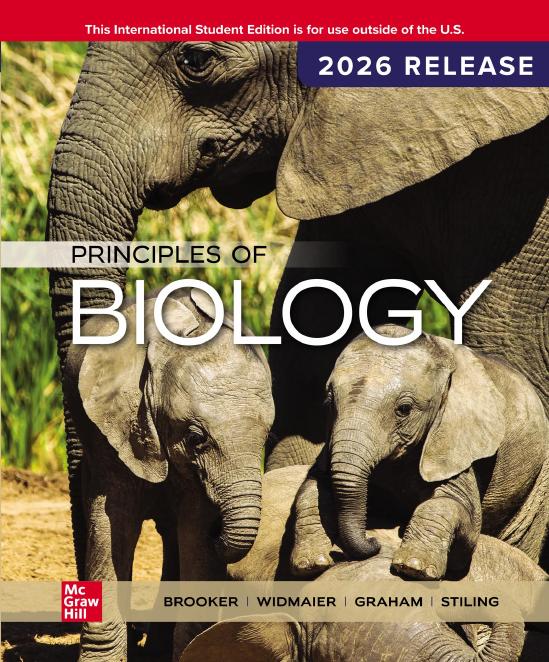
Principles of Biology 2026 Release By Robert Brooker, Eric Widmaier, Linda Graham, Peter Stiling
$30.00
Secure checkout
Instant digital download
PDF document
Document details
- Pages
- 1,195
- File size
- 1.19 MB
- Format
- Digital PDF
- Course
- Biology
- Category
- eBook[PDF]
Sign in or create a free account to continue. Your purchase will be saved in My Downloads.
About this ebook
The Principles of Biology (2026 Release, 5th Edition) by Robert Brooker, Eric Widmaier, Linda Graham, and Peter Stiling is organized into eight core thematic units. The textbook focuses on conceptual understanding and scientific critical thinking. [1, 2, 3, 4]
The structural breakdown of the topics covered in this edition includes:
Introduction & Unit I: Chemistry
- An Introduction to Biology
- Atoms, Molecules, and Water: The chemical foundation of biological systems.
- Organic Molecules: Structure and function of carbon-based life molecules. [1]
Unit II: Cells
- Origin of Cells: Basic features and evolutionary history of cellular life.
- Membranes: How the cell interface interacts with its surrounding environment.
- Energy Utilization: Metabolic pathways and cellular energy use.
- Photosynthesis: Capturing light energy to form chemical energy.
- Cell Communication: Mechanisms of interaction between cells and their environment. [1, 2]
Unit III: Genetics
- DNA and RNA: Nucleic acid structure, replication mechanisms, and chromosome structure.
- Gene Expression: Transcription and translation of genetic info.
- Non-coding RNAs: Functional RNA roles outside of protein coding.
- Gene Regulation: Mechanisms controlling genetic expression.
- Mutation and Repair: Changes to genetic material, repair pathways, and how they relate to cancer.
- Cell Division: Chromosome sorting via mitosis and meiosis.
- Mendelian Inheritance: Classic patterns of parental genetic transmission.
- Advanced Genetics: Epigenetics, genetic linkage, and extranuclear inheritance patterns.
- Microbial Genetics: Simple genetic properties of viruses, bacteria, and archaea.
- Genomics and Biotechnology: Technologies used to isolate, study, and manipulate genes. [1]
Unit IV: Evolution
- Population Changes: How frequencies shift across generations.
- Speciation: The emergence and divergence of new species. [1]
Unit V: Diversity
- Microbial Life: Diversity spanning Archaea, Bacteria, Protists, and Fungi.
- Microbiomes: The dynamics of complex microbial systems existing on and around organisms. [1]
Unit VI: Flowering Plants
- Form and Function: Structural introduction to flowering plant anatomy.
- Environmental Interaction: How plants sense, move, and respond to environmental stimuli. [1]
Unit VII: Animals
- Homeostasis: Fundamental design and baseline regulation of animal bodies.
- Neuroscience: The evolutionary structure and function of nervous systems. [1]
Unit VIII: Ecology
- Behavioral Ecology: Behavioral strategies for finding food, securing mates, and passing on genes.
- Populations and Species Interactions: Dynamics of population growth and community-level interactions. [1]
File included
tmpphpCwxAeu
1.19 MB
Related ebooks