
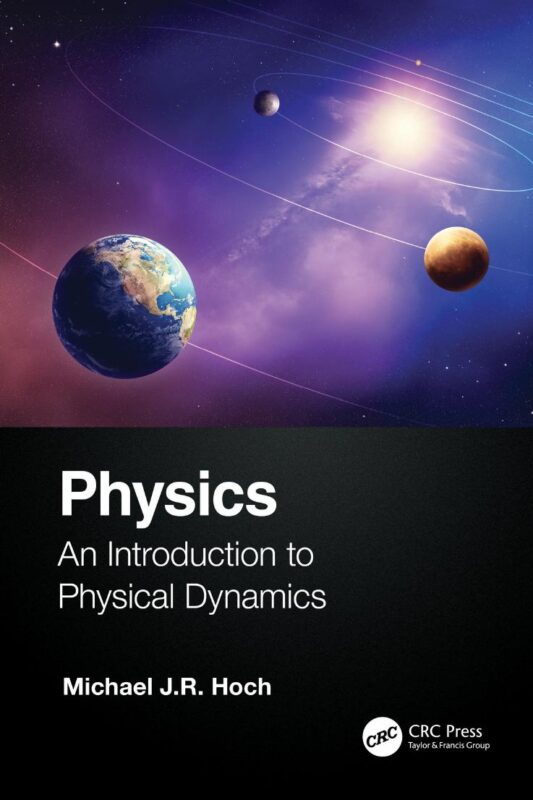
Physics: An Introduction to Physical Dynamics By Michael J.R. Hoch
$26.00
Secure checkout
Instant digital download
PDF document
Document details
- Pages
- 225
- File size
- 24.71 MB
- Format
- Digital PDF
- Course
- Education
- Category
- eBook[PDF]
Sign in or create a free account to continue. Your purchase will be saved in My Downloads.
About this ebook
Physics: An Introduction to Physical Dynamics by Michael J.R. Hoch covers classical mechanics, fluid and wave dynamics, and thermal physics across 12 chapters. The book is structured to guide undergraduate science and engineering students from the properties of rigid, inflexible objects to flexible systems and thermodynamic properties. [1, 2]
Complete Table of Chapters
Part 1: Dynamics of Inflexible Objects (Chapters 1–6)
This section introduces Newton's laws of motion and details how forces dictate the behavior of point-particles and solid, fixed 3D shapes. [1]
- Chapter 1: The Physical World (Covers SI units, atoms, the speed of light, and macroscopic forces)
- Chapter 2: Motion in Space and Time
- Chapter 3: Momentum and the Laws of Motion
- Chapter 4: Work and Mechanical Energy
- Chapter 5: Circular Motion
- Chapter 6: Rigid Body Motion [1]
Part 2: Dynamics of Flexible Systems & Waves (Chapters 7–10)
This section generalizes core mechanical energy principles to moving materials, fluids, and varying wave mediums. [1]
- Chapter 7: Fluids and Solids
- Chapter 8: Oscillations (Covers oscillating springs and simple harmonic motion)
- Chapter 9: Waves in Low Dimensions (Focuses on waves on stretched strings, sound waves, and introductory light properties)
- Chapter 10: Waves in Higher Dimensions (Deals heavily with electromagnetic waves traveling through spaces) [1, 3]
Part 3: Thermal Physics & Thermodynamics (Chapters 11–12)
The final segment transitions into heat systems and energy transfer between macro-systems at varying temperatures. [1, 2]
- Chapter 11: Basics of Thermal Physics
- Chapter 12: Entropy and the Second Law [1]
Core Conceptual Focus Areas
- Mathematical Depth: The text relies on a foundational understanding of elementary calculus to model changing systems and motion equations. [1]
- Scale Scope: Explores physical systems spanning from the astronomic scale (universal gravitation) down to the microscopic scale (atomic clocks and electrons). [1, 2]
- Problem-Solving: Every chapter is paired with structured problem sets and worked examples tailored for first-year university environments. [1, 2]
File included
tmpphp2yxoDe
24.71 MB
Related ebooks