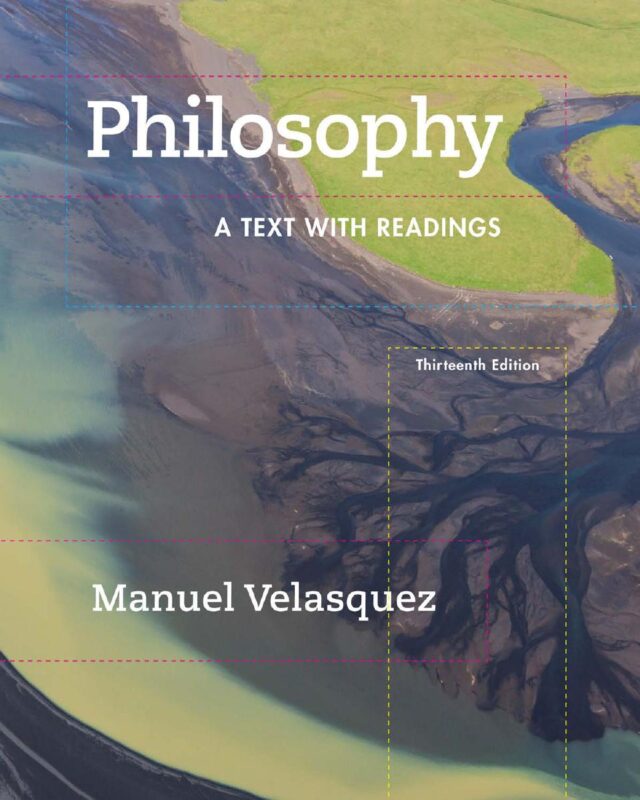
Philosophy: A Text with Readings 13th Edition By Manuel Velasquez
$28.00
Secure checkout
Instant digital download
PDF document
Document details
- Pages
- 722
- File size
- 24.14 MB
- Format
- Digital PDF
- Course
- Education
- Category
- eBook[PDF]
Sign in or create a free account to continue. Your purchase will be saved in My Downloads.
About this ebook
The 13th Edition of "Philosophy: A Text with Readings" by Manuel Velasquez covers nine primary chapters detailing the core branches and traditional divisions of Western and non-Western philosophy. [1, 2]
The book structure and major topics include:
Chapter 1: The Nature of Philosophy
- Defining Philosophy: Examines Plato's Allegory of the Cave and what it means to "do" philosophy.
- Core Divisions: Introduces the major fields of epistemology, metaphysics, and ethics.
- Socrates: Analyzes the Socratic method and structural reasoning.
- Critical Thinking: Guides readers through identifying core assumptions, logic, and avoiding ambiguous claims. [1, 2]
Chapter 2: Human Nature
- Theories of Identity: Investigates what human nature is and why we study it.
- Mind-Body Problem: Explores how physical bodies and conscious minds interact.
- The Enduring Self: Looks at personal identity over time and if the "self" exists.
- Historical Showcases: Includes readings on Plato, Aristotle, and Confucius. [1]
Chapter 3: Reality and Being (Metaphysics)
- What is Real: Questions the fundamental nature of existence.
- Material vs. Nonmaterial: Explores materialism, idealism, and dualism.
- Pragmatism & Phenomenology: Examines alternate perspectives on reality and human experience. [1]
Chapter 4: Philosophy, Religion, and God
- Existence of God: Analyzes traditional arguments (monotheism, ontological, cosmological, and teleological).
- Problem of Evil: Addresses the tension between a benevolent God and the existence of suffering.
- Religious Experience: Explores non-traditional and mystical views of divinity. [1]
Chapter 5: The Sources of Knowledge (Epistemology)
- Rationalism: Covers the belief that reason is the primary source of knowledge.
- Empiricism: Examines the stance that knowledge comes primarily from sensory experience.
- Kant & Skepticism: Introduces intellectual synthesis and the foundational limits of human knowing.
Chapter 6: Truth
- Theories of Truth: Covers correspondence, coherence, and pragmatic theories of truth.
- Scientific Truth: Examines how truth is defined, verified, and accepted within empirical sciences. [1]
Chapter 7: Ethics
- Moral Relativism: Questions whether objective moral values exist across cultures.
- Ethical Egoism & Utilitarianism: Investigates consequence-based moral reasoning.
- Duty and Virtue Ethics: Covers Kantian duty ethics alongside Aristotelian virtue frameworks. [1]
Chapter 8: Social and Political Philosophy
- Justifying the State: Explores social contract theories, individual rights, and state authority.
- Justice and Equality: Breaks down distributive justice, law, and civil rights. [1]
Chapter 9: Postscript: The Meaning of Life
- The Meaning of Existence: Looks at historical and contemporary philosophical views on human purpose. [1]
File included
tmpphpQuZ3Ug
24.14 MB
Related ebooks