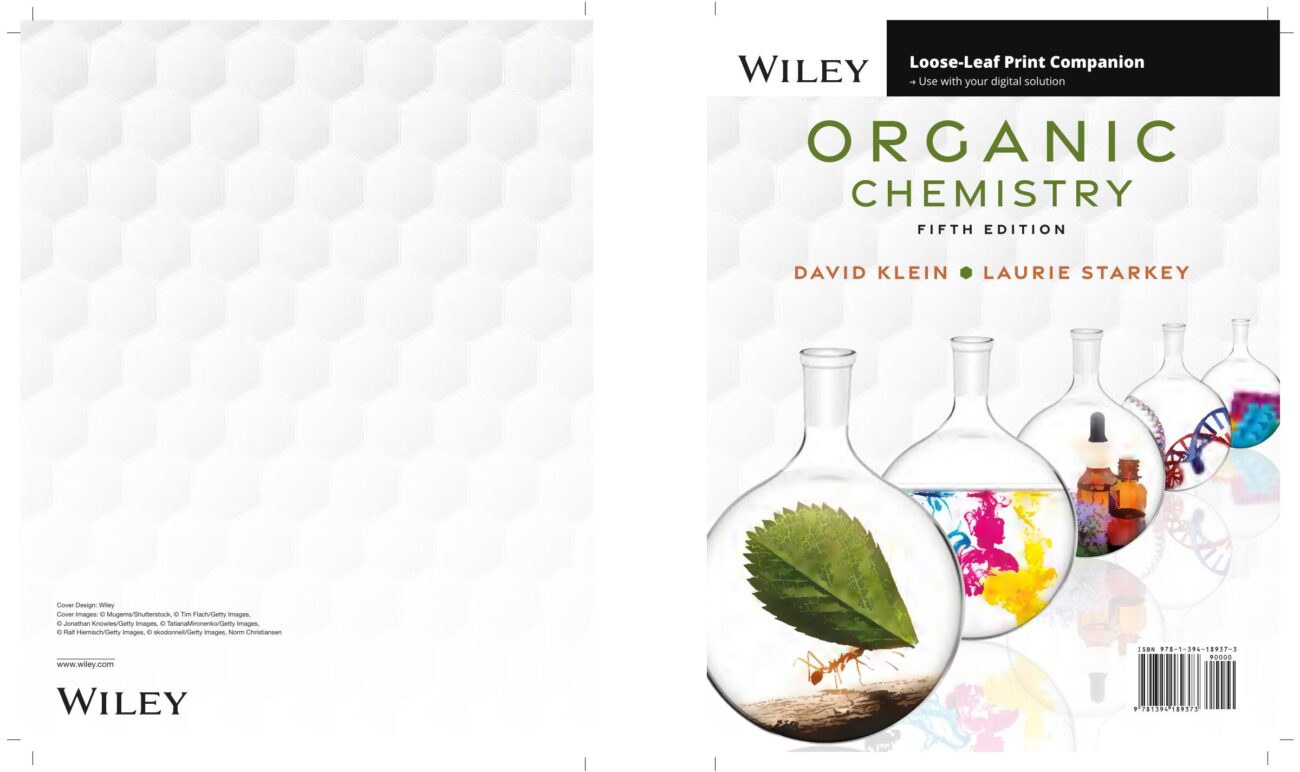
Organic Chemistry 5th Edition By David Klein, Laurie Starkey
$30.00
Secure checkout
Instant digital download
PDF document
Document details
- Pages
- 1,521
- File size
- 819.93 KB
- Format
- Digital PDF
- Course
- Chemistry
- Category
- eBook[PDF]
Sign in or create a free account to continue. Your purchase will be saved in My Downloads.
About this ebook
The Organic Chemistry 5th Edition by David R. Klein and co-author Laurie S. Starkey covers a comprehensive 27-chapter layout standard for a full-year, two-semester undergraduate chemistry course sequence. [1, 2]
The textbook topics are broadly organized into foundational concepts, functional group reactivities, analytical methods, and advanced biomolecules: [1, 2]
Semester 1: Foundations and Hydrocarbons
- Chapter 1: A Review of General Chemistry – Electrons, bonds, Lewis structures, molecular orbital theory, and hybridization.
- Chapter 2: Molecular Representations – Bond-line structures, functional groups, and resonance structures.
- Chapter 3: Acids and Bases – Brønsted-Lowry/Lewis acids, \(pK_{a}\) values, and predicting equilibrium positions.
- Chapter 4: Alkanes and Cycloalkanes – Nomenclature, Newman projections, conformational analysis, and chair conformations.
- Chapter 5: Stereochemistry – Chirality, enantiomers, diastereomers, R/S configuration, and optical activity.
- Chapter 6: Chemical Reactivity and Mechanisms – Enthalpy, entropy, Gibbs free energy, kinetics, and reading reaction coordinate diagrams.
- Chapter 7: Alkyl Halides – Nucleophilic substitution (\(S_N1/S_N2\)) and elimination (E1/E2) mechanisms.
- Chapter 8: Addition Reactions of Alkenes – Hydrohalogenation, hydration, hydroboration, halogenation, and ozonolysis.
- Chapter 9: Alkynes – Structure, synthesis, reduction, and addition reactions of triple bonds.
- Chapter 10: Radical Reactions – Free radical halogenation, anti-Markovnikov additions, and polymerization basics.
- Chapter 11: Synthesis – Strategies for designing multi-step synthesis and changing carbon frameworks. [1, 2, 3, 4]
Spectroscopy & Advanced Reactivity
- Chapter 12: Alcohols and Phenols – Structure, properties, synthesis, and substitution/oxidation reactions.
- Chapter 13: Ethers and Epoxides; Thiols and Sulfides – Preparations and ring-opening reactions.
- Chapter 14: Infrared Spectroscopy and Mass Spectrometry – Functional group identification and molecular weight determination.
- Chapter 15: Nuclear Magnetic Resonance (NMR) Spectroscopy – ¹H and ¹³C NMR, chemical shifts, integration, and spin-spin splitting.
- Chapter 16: Conjugated Pi Systems and Pericyclic Reactions – Conjugated dienes, UV-Vis spectroscopy, and Diels-Alder reactions. [1]
Semester 2: Aromatics and Carbonyl Chemistry
- Chapter 17: Aromatic Compounds – Hückel's rule, aromaticity, and nomenclature of benzene derivatives.
- Chapter 18: Electrophilic Aromatic Substitution – Halogenation, nitration, sulfonation, Friedel-Crafts reactions, and substituent directing effects.
- Chapter 19: Aldehydes and Ketones – Nucleophilic addition reactions (acetals, imines, Wittig reaction).
- Chapter 20: Carboxylic Acids and Their Derivatives – Nucleophilic acyl substitution of esters, amides, acid chlorides, and nitriles.
- Chapter 21: Alpha Carbon Chemistry – Enols, enolates, aldol reactions, Claisen condensations, and alkylation.
- Chapter 22: Amines – Preparation, properties, and specific transformations like the Hofmann elimination. [1, 2]
Special Topics and Biomolecules
- Chapter 23: Introduction to Organometallic Compounds – Grignard reagents, organolithium reagents, and transition-metal catalyzed cross-coupling.
- Chapter 24: Carbohydrates – Monosaccharides, stereochemistry, cyclic structures, and disaccharides.
- Chapter 25: Amino Acids, Peptides, and Proteins – Structure, synthesis, sequencing, and peptide bond formation.
- Chapter 26: Lipids – Waxes, triglycerides, phospholipids, steroids, and biosynthesis trends.
- Chapter 27: Synthetic Polymers – Chain-growth and step-growth polymerization pathways. [1]
File included
tmpphpbkBUfj
819.93 KB
Related ebooks