
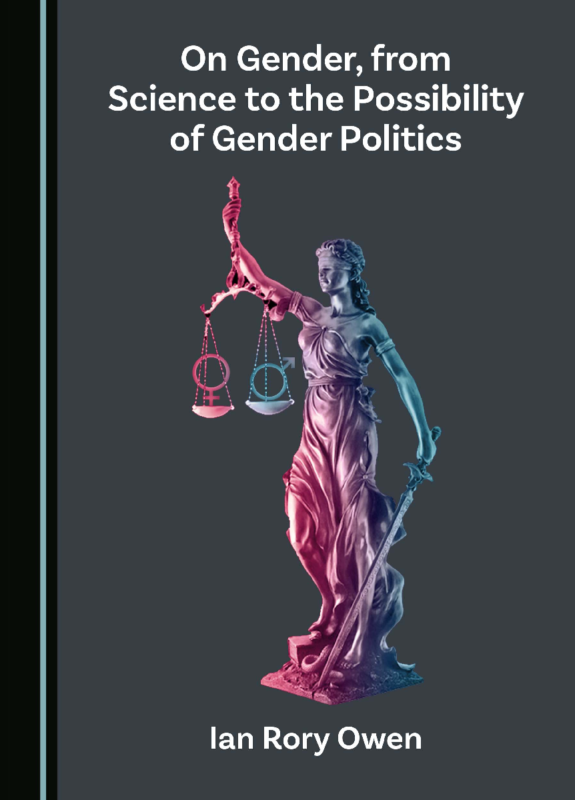
On Gender from Science to the Possibility of Gender Politics By Ian Rory Owen
$30.00
Secure checkout
Instant digital download
PDF document
Document details
- Pages
- 242
- File size
- 1.74 MB
- Format
- Digital PDF
- Course
- Social Sciences
- Category
- eBook[PDF]
Sign in or create a free account to continue. Your purchase will be saved in My Downloads.
About this ebook
On Gender, from Science to the Possibility of Gender Politics (published in 2024) by psychotherapist Ian Rory Owen explores the existential and qualitative dimensions of gender. The book blends classical phenomenology with empirical scientific research to analyze how gender roles form and how they can inform modern gender politics. [1, 2, 3]
The primary topics and themes covered in the book include:
Classical Phenomenology and Philosophy
- Philosophical Frameworks: Applies the core theories of Immanuel Kant, Edmund Husserl, and Martin Heidegger to understand human beings as inherently gendered. [1, 2]
- Existential Dimensions: Provides intellectual tools to examine the lived, qualitative appearances of everyday human existence rather than reducing identity to rigid binaries. [1, 2]
- Historical Academic Tensions: Explores the precise differences and intellectual tensions between Husserl and Heidegger during their time working together. [1]
- Simone de Beauvoir's Theories: Integrates her structural analysis of the masculine-feminine balance of power. [1]
Empirical and Multi-Disciplinary Science
- Cross-Disciplinary Commentary: Critiques and synthesizes select empirical data from individual psychology, personality theory, social psychology, cultural anthropology, biology, behavioral genetics, and neuroscience. [1]
- Nature vs. Nurture Co-occurrence: Explains how biological factors and social upbringing interact developmentally to shape how individuals identify with social gender types. [1]
- Psychological Commonalities: Highlights empirical research (tracing back to early psychological findings like those of Edward Thorndike) showing that biological males and females exhibit massive statistical similarities and minimal differences in aptitude and personality. [1, 2]
Gender Identity and Social Mechanics
- Everyday Meaningful Space: Looks at the family, cultural, and societal environments where generations develop and absorb qualitative meaning. [1]
- Social Type Gender Identification: Evaluates how gender expressions and roles are built by aligning oneself with broader social archetypes. [1]
- Boundary Dynamics: Examines "trouble cases" and inter-gender boundary dynamics to analyze the limits and parameters of traditional gender roles. [1, 2]
Transgender Experience and Equity Politics
- Unity of Experience: Synthesizes data from natal gender research alongside empirical studies of transgender experiences.
- Gender Equity: Uses scientific and philosophical findings to build a rational framework aimed at achieving suitable gender equity as a political outcome. [1, 2]
File included
tmpphp3TXTHa
1.74 MB
Related ebooks