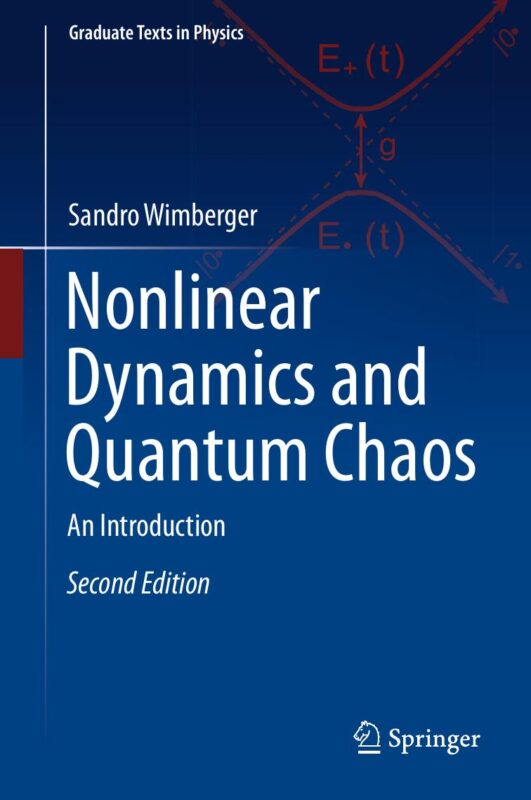
Nonlinear Dynamics and Quantum Chaos: An Introduction 2nd Edition By Sandro Wimberger
$30.00
Secure checkout
Instant digital download
PDF document
Document details
- Pages
- 270
- File size
- 5.64 MB
- Format
- Digital PDF
- Course
- Applied Thermodynamics
- Category
- eBook[PDF]
Sign in or create a free account to continue. Your purchase will be saved in My Downloads.
About this ebook
The second edition of Nonlinear Dynamics and Quantum Chaos: An Introduction by Sandro Wimberger (published by Springer) expands upon the first edition by offering an integrated approach to classical and quantum chaotic systems. [1, 2]
The defining addition of the 2nd edition is a brand-new chapter dedicated specifically to dissipative nonlinear systems. [1]
The primary topics and core thematic chapters covered in the text include:
1. Fundamentals of Dynamical Systems
- Formal Definitions: Mathematical frameworks for defining both classical and quantum dynamical systems.
- Discrete Maps: Detailed exploration of one-dimensional discrete mappings (e.g., the logistic map) to illustrate fundamental chaotic behavior.
- Chaotic Metrics: Core introductory tools used to diagnose and classify the properties of regular versus chaotic trajectories. [1]
2. Classical Nonlinear Hamiltonian Systems
- Hamiltonian Mechanics: A review of the foundational concepts of continuous classical mechanics.
- Integrability: Defining regular, predictable motion and the conditions under which a system is integrable.
- Non-Integrability & Chaos: The transition from regular phase spaces to chaotic ones when perturbation destroys integrability. [, 2]
3. Dissipative Nonlinear Systems (New to the 2nd Edition)
- Dissipative Dynamics: Moving beyond ideal Hamiltonian (energy-conserving) systems to analyze friction, damping, and energy-loss mechanisms.
- Attractors: Study of stable fixed points, limit cycles, and strange attractors that characterize chaotic dissipation.
- Bifurcation Theory: Analysis of how system states qualitatively split and transition into chaos as control parameters change. [1, 3]
4. Quantum Chaos & Semiclassics
- Semiclassical Analysis: Comparing quantum evolution to classical analogs, blending classical intuition with quantum wave functions. []
- Spectral Properties: Characterizing quantum chaoticity using the properties of the quantum energy spectrum. []
- Random Matrix Theory (RMT): Utilizing random matrix ensembles to model and describe energy level statistics in highly chaotic quantum regimes. [1, 2, 3]
- Quantum Localization: Phenomena such as dynamical localization (analogous to Anderson localization) where quantum interference suppresses classical chaotic diffusion. [, 2]
5. Practical Learning Elements
File included
tmpphpjTGPlR
5.64 MB
Related ebooks