
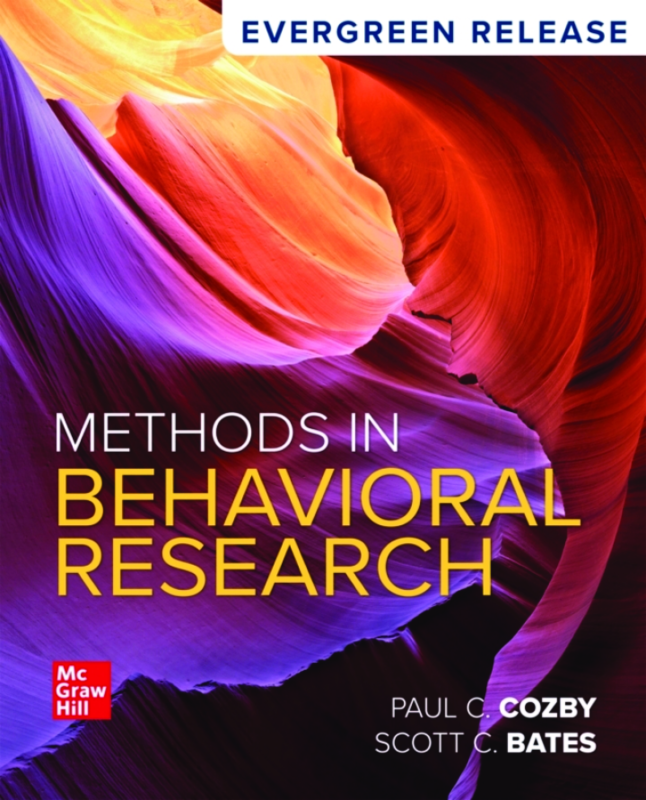
Methods in Behavioral Research 2026 EverGreen Release By Paul C. Cozby, Scott Bates
$30.00
Secure checkout
Instant digital download
PDF document
Document details
- Pages
- 513
- File size
- 7.01 MB
- Format
- Digital PDF
- Course
- Psychology
- Category
- eBook[PDF]
Sign in or create a free account to continue. Your purchase will be saved in My Downloads.
About this ebook
Methods in Behavioral Research: 2026 Release (the "EverGreen" continuous update release) by Paul C. Cozby and Scott Bates is a market-leading textbook published by McGraw-Hill Higher Education. It is widely used in psychology, sociology, and behavioral sciences to teach the foundational principles of scientific inquiry and empirical research design. [1, 2, 3, 4, 5]
Key Textbook Details
- Authors: Paul C. Cozby (Emeritus Professor at California State University, Fullerton) and Scott Bates (Utah State University).
- Core Identifiers: ISBN-10: 1264849699 | ISBN-13: 9781264849697.
- Current Edition Format: Instead of a traditional 15th or 16th edition number, McGraw-Hill now provides this under their continuous updating standard as the 2026 Release.
- Official Publisher Access: Available as an eBook or with digital platform tools on the official McGraw-Hill Higher Education Page. [1, 2, 3, 4]
What is New in the 2026 Release?
This edition preserves its classic, straightforward writing style while modernizing the context to better reflect contemporary research challenges: [1, 2, 3, 4, 5]
- Diversity, Equity, & Inclusion (DEI): Focuses heavily on the universal generalizability of past scientific data, prompting students to critically analyze diversity in participant sampling. [1, 2]
- APA 7th Edition Alignment: Formatting guidelines and citations are thoroughly updated to match the newest American Psychological Association standards. [1, 2]
- Modern Research Examples: Features relatable, updated case studies including the psychological impact of COVID-19 and behavioral patterns behind Instagram and social media usage. [1, 2]
Chapter Structure & Content Map
- Scientific Understanding of Behavior: Empiricism, intuition, and the difference between basic and applied science.
- Where to Start: Generating hypotheses, searching literature databases, and evaluating existing studies.
- Ethics in Behavioral Research: Deep focus on the Belmont Report, institutional review boards (IRBs), and modern digital participant ethics.
- Fundamental Research Issues: Exploring operational definitions, validity types, and experimental vs. nonexperimental methods.
- Measurement Concepts: Reviewing variables, scale types (nominal, ordinal, interval, ratio), reliability, and measurement validity.
- Observational Methods: Qualitative and quantitative observation, naturalistic studies, and case analysis.
- Survey Research: Designing interviews, preventing questionnaire bias, and studying sampling methodologies.
- Experimental Design: Independent vs. dependent variables, posttest-only, and pretest-posttest formats.
- Conducting Experiments: Managing participant expectations, blind studies, and manipulation checks.
- Complex Experimental Designs: Factorial designs and interpreting main effects vs. interaction effects.
- Quasi-Experimental & Developmental Designs: Single-case structures, cohort effects, longitudinal studies, and cross-sectional designs.
- Descriptive & Correlational Results: Effect sizes, correlation coefficients, and descriptive statistics.
- Statistical Inference: Null hypotheses, alpha levels, \(t\)-tests, \(F\)-tests, and avoiding Type I / Type II errors.
- Generalization: Replicating results, meta-analyses, and the impact of cross-cultural variations. [1, 2, 3, 4, 5]
File included
tmpphpg3DEIB
7.01 MB
Related ebooks