
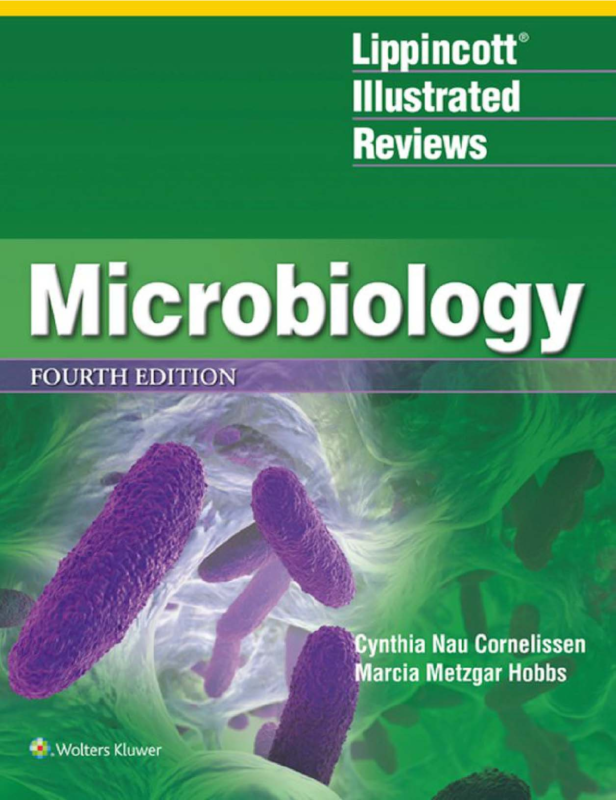
eBook Lippincott Illustrated Reviews Microbiology 4th Edition By Cynthia Nau Cornelissen, Marcia Metzgar Hobbs –
$30.00
Secure checkout
Instant digital download
PDF document
Document details
- Pages
- 460
- File size
- 257.12 MB
- Format
- Digital PDF
- Course
- Microbiology
- Category
- eBook[PDF]
Sign in or create a free account to continue. Your purchase will be saved in My Downloads.
About this ebook
The Lippincott Illustrated Reviews: Microbiology (4th Edition) by Cynthia Nau Cornelissen and Marcia Metzgar Hobbs is structured into five primary units that cover the essential foundations of medical microbiology, immunology basics, pathogens, and clinical applications. [1, 2, 3]
Unit I: The Microbial World
Focuses on foundational principles, host-microbe interactions, and the tools used to combat infections. [1, 2]
- Introduction to Microbiology: Overview of typical vs. atypical microorganisms.
- Normal Flora: The human microbiome and benign resident microbes.
- Pathogenicity of Microorganisms: Microbial virulence factors and mechanisms of disease.
- Diagnostic Microbiology: Laboratory techniques, cultures, and diagnostic testing.
- Vaccines and Antimicrobial Agents: Pharmacology principles of antibiotics, antifungals, antivirals, and immunization strategies. [1, 2, 3]
Unit II: Bacteria
A comprehensive review of bacterial genetics, structures, and clinically significant medical bacteriology. [1, 2]
- Bacterial Structure, Growth, and Metabolism: Morphological features and metabolic pathways.
- Bacterial Genetics: Mutation, gene transfer, and resistance acquisition.
- Gram-Positive Cocci: Staphylococci and Streptococci.
- Gram-Positive Rods: Spore-forming and non-spore-forming bacilli (e.g., Bacillus, Listeria).
- Gram-Negative Cocci: Neisseriae species.
- Gram-Negative Rods: Gastrointestinal enterics (e.g., E. coli, Salmonella) and other aerobic rods (e.g., Pseudomonas).
- Anaerobes: Clostridia and other anaerobic organisms.
- Spirochetes: Treponema, Borrelia, and Leptospira.
- Atypical & Intracellular Bacteria: Mycoplasma, Chlamydiae, Mycobacteria (tuberculosis and leprosy), Actinomycetes, Rickettsia, Ehrlichia, Anaplasma, and Coxiella. [1, 2, 3, 4]
Unit III: Fungi and Parasites
- Fungi: Cutaneous, subcutaneous, systemic, and opportunistic fungal infections.
- Protozoa: Intestinal, urogenital, and blood/tissue parasites (e.g., Plasmodium, Amoeba).
- Helminths: Nematodes, trematodes, and cestodes (worms). [1]
Unit IV: Viruses
Breaks down the virology landscape based on structural classification and viral replication strategies. [1, 2]
- Introduction to the Viruses: General viral structure and replication lifecycles.
- DNA Viruses: Nonenveloped DNA viruses and Enveloped DNA viruses.
- Hepatitis Viruses: Focused target strategies for Hepatitis B and Hepatitis D (Delta) viruses.
- RNA Viruses: Positive-strand RNA viruses, Negative-strand RNA viruses, and Double-stranded RNA viruses (Reoviridae).
- Retroviruses: Human immunodeficiency virus (HIV) biology and pathogenesis.
- Unconventional Infectious Agents: Prions and subviral particles. [1, 2]
Unit V: Clinical Microbiology Review
File included
eBook-PDF-Lippincott-Illustrated-Reviews-Microbiology-4th-Edition-By-Cynthia-Nau-Cornelissen-Marcia-Metzgar-Hobbs-.pdf
257.12 MB
Related ebooks



