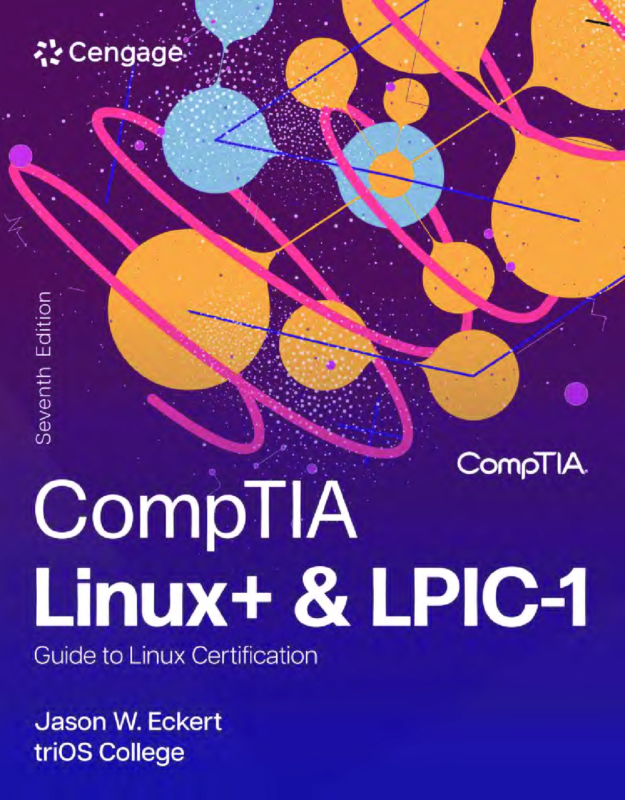
Linux+ and Lpic-1 Guide to Linux Certification 7th Edition By Jason Eckert
$30.00
Secure checkout
Instant digital download
PDF document
Document details
- Pages
- 786
- File size
- 7.22 MB
- Format
- Digital PDF
- Course
- Education
- Category
- eBook[PDF]
Sign in or create a free account to continue. Your purchase will be saved in My Downloads.
About this ebook
Jason Eckert's CompTIA Linux+ and LPIC-1 Guide to Linux Certification, 7th Edition covers foundational and advanced Linux administration, modern cloud infrastructure, and automation. It is specifically mapped to prepare readers for the CompTIA Linux+ (XK0-006) exam and the Linux Professional Institute LPIC-1 (101-500 and 102-500) exams. [1, 2, 3, 4]
Core Architecture & System Management
-
- Operating System Foundations: Understanding different Linux distributions, kernel architecture, open-source licensing, and typical use cases. [1, 2, 3, 4]
- Installation and Package Management: Installing Linux (using modern Fedora and Ubuntu distributions), configuring GRUB/system boot processes, and handling software via repositories. [1, 2, 3, 4, 5]
- Filesystem Administration: Navigating, managing, and securing filesystems, configuring advanced storage tools, LVM (Logical Volume Management), RAID configurations, and enterprise storage. [1, 2, 3]
- The Linux Shell & Processes: Executing shell commands, managing environment variables, manipulating text, and monitoring, text filtering, or terminating Linux processes. [1, 2, 3, 4]
Networking & Security
-
- Network Configurations: Configuring network interfaces, hostnames, dynamic and static routing, and utilizing core diagnostic tools.
- Critical Networking Services: Setting up and deploying essential tools including DNS, DHCP, NTP, PTP, SSH, VNC, RDP, FTP, Samba, Apache, Nginx, Postfix, and PostgreSQL.
- Security & Troubleshooting: Establishing system firewalls, hardening local security policies, managing users/groups, and diagnosing system health issues. [1, 2, 3, 4, 5]
Cloud, Automation, & Next-Gen Technologies
-
- Virtualization & Containers: Creating and administering virtual machines, deploying containerized software using Docker, and working with Kubernetes.
- Cloud Orchestration & Configuration Management: Learning Infrastructure as Code concepts and deploying configuration management models using Ansible.
- AI & Automation: Integrating artificial intelligence tools, automation scripts, and efficiency methods into modern enterprise Linux workflows. [1, 2]
Scripting & Skill Portability (Appendices)
- Python Scripting: Applying automation knowledge natively through the Python programming language.
- Cross-OS Skills: Transferring existing Linux administration, terminal, and command-line knowledge over to macOS and FreeBSD environments. [1]
File included
tmpphpXrlGQR
7.22 MB
Related ebooks