
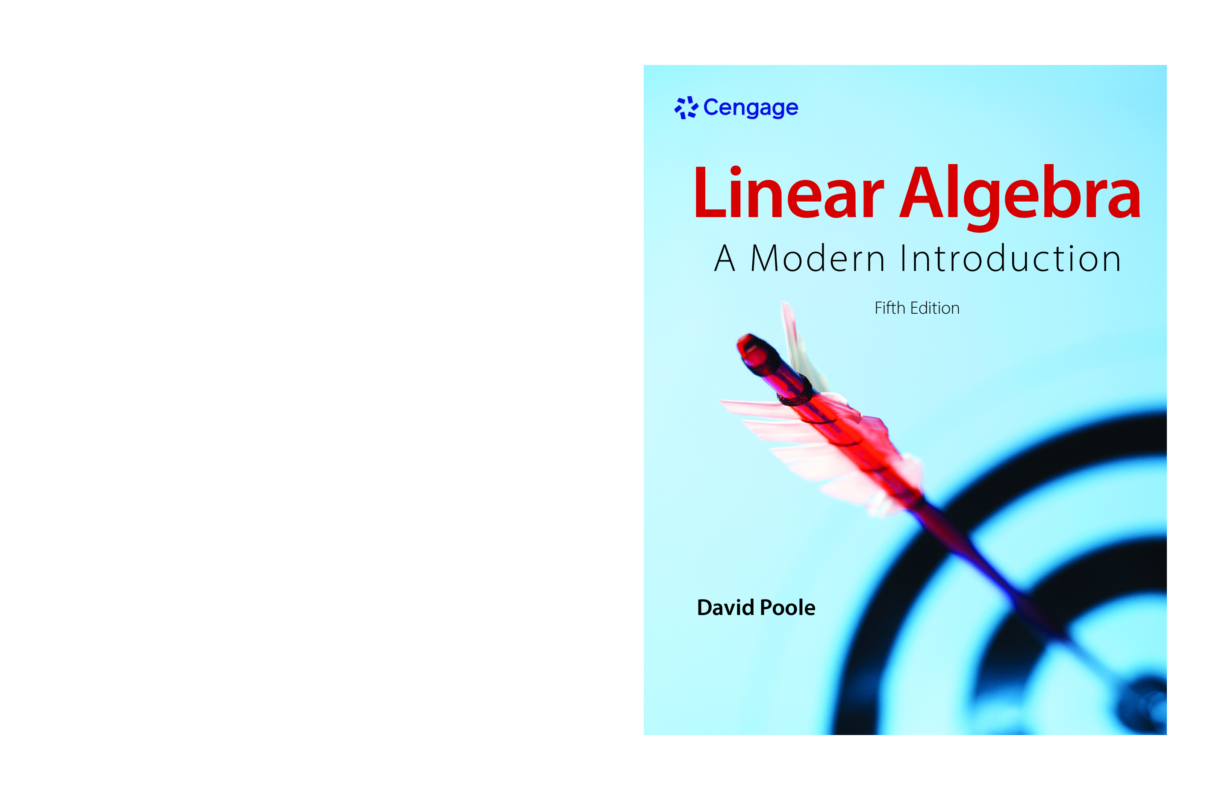
Linear Algebra: A Modern Introduction 5th Edition By David Poole
$30.00
Secure checkout
Instant digital download
PDF document
Document details
- Pages
- 660
- File size
- 21.53 MB
- Format
- Digital PDF
- Course
- Mathematics
- Category
- eBook[PDF]
Sign in or create a free account to continue. Your purchase will be saved in My Downloads.
About this ebook
Linear Algebra: A Modern Introduction (5th Edition) by David Poole covers eight core chapters designed to transition students from computational matrix calculations to abstract, theoretical mathematics. [1, 2]
The structural blueprint of the topics covered in this edition includes:
1. Vectors
- The Geometry and Algebra of Vectors: Vector operations, geometric interpretations, and linear combinations.
- Length and Angle: The dot product, norm, distance formula, and Cauchy-Schwarz inequality.
- Lines and Planes: Vector and parametric equations of paths and surfaces in \(\mathbb{R}^{n}\).
- Applications: Code vectors, force vectors, and modern optimization models. [1, 2, 3, 4, 5]
2. Systems of Linear Equations
- Introduction to Systems: Identifying unique, infinite, or no-solution systems geometrically.
- Direct Methods for Solving: Gaussian elimination, Gauss-Jordan elimination, and row echelon forms.
- Spanning Sets and Linear Independence: Conceptual foundational blocks for abstract spaces.
- Applications: Allocation of resources, network analysis, and chemical balancing. [1, 2, 3, 4]
3. Matrices
- Matrix Operations: Matrix addition, scalar multiplication, and matrix-matrix multiplication.
- Matrix Algebra: Properties of matrices, the transpose, and symmetric matrices.
- The Matrix Inverse: Computing inverses and understanding invertible matrix properties.
- The LU Factorization: Decomposing matrices for efficient computer architectures. [1, 2, 3, 4, 5]
4. Eigenvalues and Eigenvectors
- Introduction to Eigenvalues/Eigenvectors: Determinants, characteristic polynomials, and eigenspaces.
- Similarity and Diagonalization: Transforming matrices into simpler diagonal structures.
- Iterative Methods: Power method for calculating dominant eigenvalues.
- Applications: Markov chains, population growth models (Leslie matrices), and Google's PageRank algorithm. [1, 2, 3, 4, 5]
5. Orthogonality
- Orthogonality in \(\mathbb{R}^{n}\): Orthogonal complements, orthogonal bases, and projections.
- The Gram-Schmidt Process: Constructing orthogonal bases and the QR Factorization.
- Orthogonal Matrices: Properties and uses in geometric rotations.
- Applications: Dual codes and basic signal compression. [1, 2, 3]
6. Vector Spaces
- Vector Spaces and Subspaces: Axioms, definitions, and verification of general spaces.
- Linear Independence, Basis, and Dimension: Coordinates, coordinate vectors, and the dimension theorem.
- Null Space and Column Space: Finding bases for fundamental matrix spaces.
- Linear Transformations: Kernel, range, and building matrices of transformations. [1, 2, 3, 4, 5]
7. Distance and Approximation
- Inner Product Spaces: Generalizing dot products to functions and matrices.
- Least Squares Approximation: Finding the best fit for overdetermined systems.
- The Singular Value Decomposition (SVD): Decomposing any matrix into fundamental building blocks for modern data science. [1, 2, 3]
8. Codes
File included
tmpphpSnofcP
21.53 MB
Related ebooks