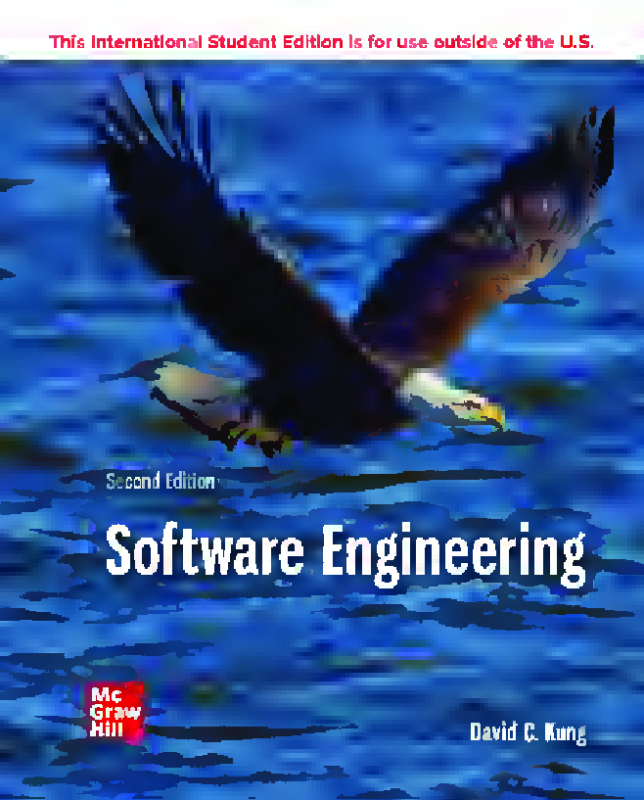
Software Engineering: An Agile Unified Methodology ISE 2nd Edition by David C. Kung
$30.00
Secure checkout
Instant digital download
PDF document
Document details
- Pages
- 687
- File size
- 11.23 MB
- Format
- Digital PDF
- Course
- Engineering
- Category
- eBook[PDF]
Sign in or create a free account to continue. Your purchase will be saved in My Downloads.
About this ebook
Software Engineering: An Agile Unified Methodology (ISE 2nd Edition) by David C. Kung covers a comprehensive lifecycle approach. The core content spans 24 chapters structured into eight core parts. It blends traditional software engineering concepts with object-oriented analysis, UML modeling, design patterns, and agile methodologies. [1, 2, 3]
Part I: Introduction and System Engineering
- Chapter 1: Introduction – Foundations of software engineering, challenges, and cost factors.
- Chapter 2: Software Process and Methodology – Process models, agile methodologies, and the difference between a process and methodology.
- Chapter 3: System Engineering – Context of broader systems, hardware-software trade-offs, and system analysis. [1, 2, 3]
Part II: Analysis and Architectural Design
- Chapter 4: Software Requirements Elicitation – Gathering, formatting, and negotiating user requirements.
- Chapter 5: Domain Modeling – Creating domain conceptual models and structural class diagrams.
- Chapter 6: Architectural Design – High-level system architecture patterns, styles, and decomposing systems into subsystems. [1, 2]
Part III: Modeling and Design of Interactive Systems
- Use Case Identification – Extracting actor-system boundaries and scenarios from requirements.
- Interaction Behavior – Modeling object collaboration and sequence flows.
- Responsibility Assignment Patterns – Implementing GRASP and SOLID design principles.
- Design Class Diagrams – Formulating the final architectural blueprint for programmers.
- User Interface Design – Human-computer interaction (HCI) frameworks. [, 2]
Part IV: Modeling and Design of Other System Types
- Event-Driven Systems – Designing reactive and state-dependent architectures.
- Transformational Systems – Data flow design and pipeline architectures.
- Business Rule-Based Systems – Extracting and processing logic separate from core code. []
Part V: Applying Situation-Specific Patterns
- Design Pattern Case Studies – Practical application of standard GoF (Gang of Four) patterns.
- State Diagram Editor – Walking through a complex project build from design to logic. []
Part VI: Implementation and Quality Assurance
- Implementation Considerations – Mapping design mappings to object-oriented code.
- Software Quality Assurance (SQA) – Quality metrics, formal technical reviews, and inspections.
- Software Testing – Test-driven development (TDD), unit, integration, and system testing. [1, 3]
Part VII: Maintenance and Configuration Management
- Software Maintenance – Refactoring, legacy systems, and dealing with technical debt.
- Software Configuration Management (SCM) – Version control, branching strategies, and release pipelines. [1, 2, 3]
Part VIII: Project Management and Software Security
File included
tmpphpl21bEZ
11.23 MB
Related ebooks