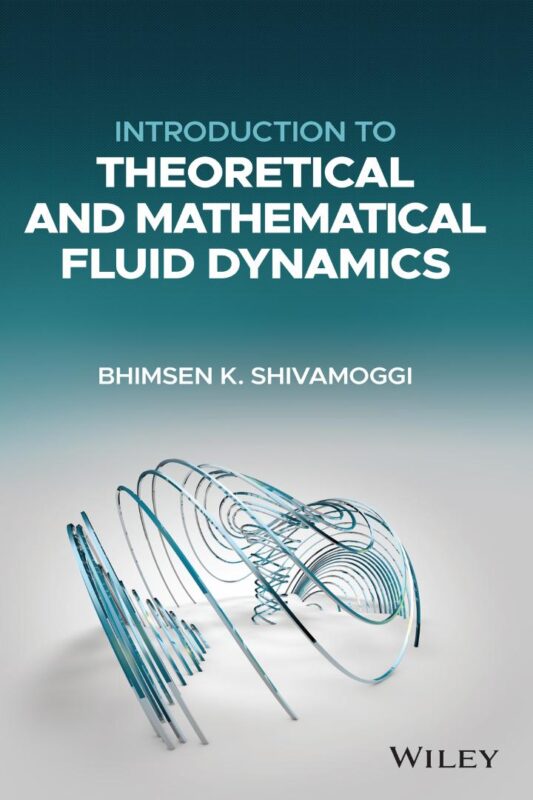
Introduction to Theoretical and Mathematical Fluid Dynamics 1st Edition By Bhimsen Shivamoggi
$30.00
Secure checkout
Instant digital download
PDF document
Document details
- Pages
- 576
- File size
- 14.45 MB
- Format
- Digital PDF
- Course
- Engineering
- Category
- eBook[PDF]
Sign in or create a free account to continue. Your purchase will be saved in My Downloads.
About this ebook
Introduction to Theoretical and Mathematical Fluid Dynamics (1st Edition) by Dr. Bhimsen K. Shivamoggi provides foundational and graduate-level coverage of fluid behaviors from a rigorous mathematical perspective. Published by Wiley, the text is divided into four main parts tracking the mathematical modeling of incompressible, compressible, and viscous flows. [1, 2, 3]
The primary topics and chapters covered in the book include:
Part I: Basic Concepts and Equations of Fluid Dynamics
- Introduction to the Fluid Model: Explores the macro-level fluid state, description of the flow-field, volume and surface forces, relative motion near a point, and stress-strain relationships. [1, 2]
- Equations of Fluid Flows: Derives essential kinematics using the Transport Theorem, material derivatives, and the law of conservation of mass and momentum. [1]
- Hamiltonian Formulation of Fluid Flows: Introduces advanced analytical mechanics applied directly to fluid flow regimes. [1]
- Surface Tension Effects: Mathematical treatment of capillary actions and boundary conditions across interfaces. [1]
Part II: Dynamics of Incompressible Fluid Flows
- Fluid Kinematics and Dynamics: Fundamental theorems governing ideal, continuous, and frictionless incompressible fluid particles. [1]
- The Complex-Variable Method: Utilizes conformal mapping, complex potentials, and analytic functions to model two-dimensional fluid physics. [1]
- Three-Dimensional Irrotational Flow: Mathematical analysis of velocity potentials, Laplace equations, and solid body interactions in 3D. [1]
- Vortex Flow: Study of vorticity, vortex filaments, theorems by Helmholtz and Kelvin, and vortex interactions. [1]
- Rotating Flow: Examines the effects of Coriolis and centrifugal forces on fluid currents. [1]
- Water Waves: Mathematical formulation of surface waves, deep-water equations, and shallow-water waves. [1]
Part III: Dynamics of Compressible Fluid Flows
- Review of Thermodynamics: Establishes energy state equations, speed of sound, and thermodynamic properties needed for gas dynamics.
- Isentropic Fluid Flow: Analyzes reversible adiabatic flows, stagnation states, and nozzle flows.
- Potential Flow: Covers linearized compressible flows and aerodynamic equations.
- Nonlinear Theory of Plane Sound Waves: Focuses on wave propagation, steepening, and characteristics of finite amplitude waves.
- Shock Waves: Examines Rankine-Hugoniot relations, normal and oblique shock formations, and supersonic transitions.
- The Hodograph Method: Implements a transform method to linearize equations of compressible fluid flow. [1]
Part IV: Dynamics of Viscous Fluid Flows
- Exact Solutions to Navier-Stokes: Mathematical modeling of laminar flow configurations and viscous stress tensor calculations.
- Low Reynolds Number Flows: Explores Stokes flow, Oseen's approximation, and lubrication theories.
- High Reynolds Number Flows & Shear Layers: Evaluates boundary layer theories, Prandtl approximations, and separation phenomena.
- Jet Flow and Wake Flow: Focuses on laminar/turbulent free-shear velocity distributions downstream of orifices or obstructions. [1, 2, 3]
File included
tmpphpJGCEuj
14.45 MB
Related ebooks