
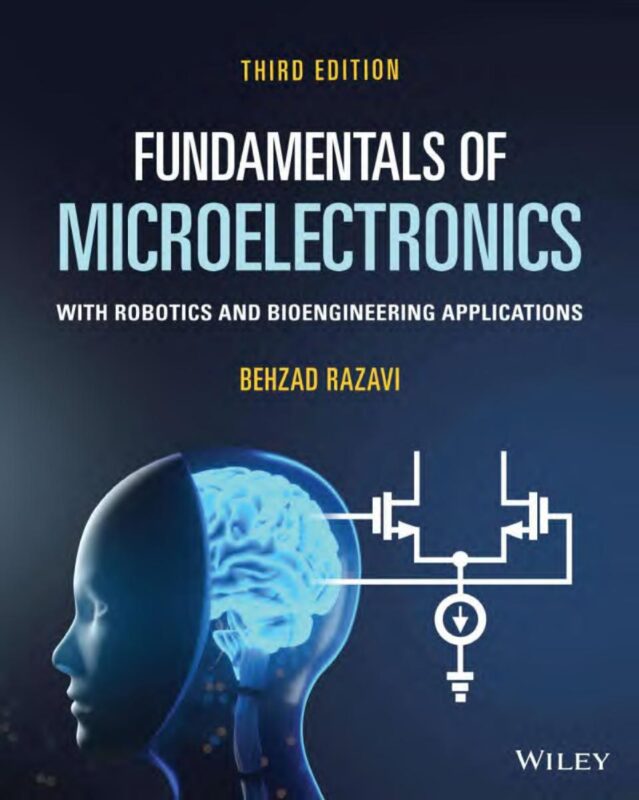
Fundamentals of Microelectronics 3rd Edition By Behzad Razavi
$30.00
Secure checkout
Instant digital download
PDF document
Document details
- Pages
- 954
- File size
- 48.73 MB
- Format
- Digital PDF
- Course
- Engineering
- Category
- eBook[PDF]
Sign in or create a free account to continue. Your purchase will be saved in My Downloads.
About this ebook
The 3rd Edition of Behzad Razavi's Fundamentals of Microelectronics covers core undergraduate analog and digital electronic circuit analysis and design. [1, 2]
The book is globally structured around a signature "analysis by inspection" framework to help students deconstruct complex integrated circuits into foundational blocks. [1, 2]
Core Chapters and Topics
- Chapter 1: Introduction to Microelectronics
- Chapter 2: Basic Physics of Semiconductors
- Chapter 3: Diode Models and Circuits
- Chapter 4: Physics of Bipolar Transistors
- Structure and operation of Bipolar Junction Transistors (BJTs).
- BJT active mode operation and current-voltage characteristics.
- BJT large-signal and small-signal models. [1]
- Chapter 5: Bipolar Amplifiers
- Input/output impedance and biasing configurations.
- Common-Emitter (CE), Common-Base (CB), and Emitter-Follower (CC) topologies. [1]
- Chapter 6: Physics of MOS Transistors
- Structure and physical operation of MOSFETs.
- Derivation of I-V characteristics in triode and saturation regions.
- MOSFET small-signal models and secondary effects (body effect, channel-length modulation). [1]
- Chapter 7: CMOS Amplifiers
- Biasing techniques for MOS circuits.
- Common-Source (CS), Common-Gate (CG), and Source-Follower (CD) topologies. [1]
- Chapter 8: Operational Amplifier as a Black Box
- Properties of ideal op-amps.
- Inverting, non-inverting, summing, and differential configurations.
- Non-ideal effects (finite gain, offset voltage, bias current, slew rate). [1]
- Chapter 9: Cascode Stages and Current Mirrors
- Bipolar and MOS cascode amplifiers.
- Basic and active current mirrors. [1]
- Chapter 10: Differential Amplifiers
- Bipolar and MOS differential pairs.
- Common-mode and differential-mode responses. [1]
- Chapter 11: Frequency Response
- High-frequency models of BJTs and MOSFETs.
- Miller's theorem and poles/zeros in amplifier configurations.
- Chapter 12: Feedback
- Properties of negative feedback systems.
- Feedback topologies (Voltage-Voltage, Voltage-Current, Current-Voltage, Current-Current).
- Effect of feedback on input/output impedances and stability.
- Chapter 13: Oscillators (Expanded/Revised in 3rd Ed)
- Barkhausen's criteria for oscillation.
- Ring oscillators, LC oscillators, and Wien-bridge circuit configurations. [1]
- Chapter 14: Output Stages and Power Amplifiers
- Class A, Class B, and Class AB power output configurations.
- Power efficiency and distortion analysis.
- Chapter 15: Analog Filters
- First-order and second-order filter approximations.
- Active filter topologies (Sallen-Key circuits).
- Chapter 16: Digital CMOS Circuits
- Static characteristics of the CMOS inverter.
- Dynamic power consumption and propagation delay in digital gates.
Pedagogy and Software Support
File included
tmpphp3IYS88
48.73 MB
Related ebooks