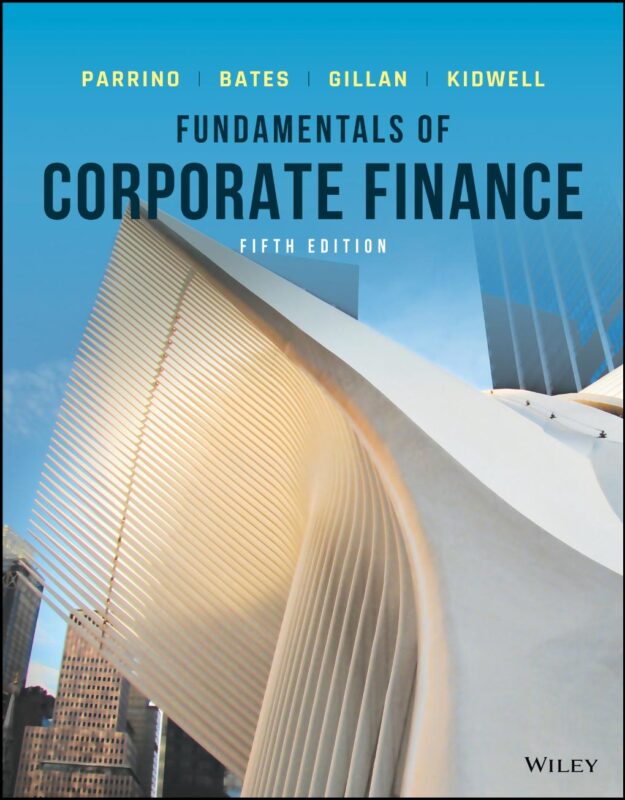
Fundamentals of Corporate Finance, 5th Edition By Bates, Thomas, Gillan, Stuart L., Parrino
$30.00
Secure checkout
Instant digital download
PDF document
Document details
- Pages
- 834
- File size
- 26.9 MB
- Format
- Digital PDF
- Course
- Education
- Category
- eBook[PDF]
Sign in or create a free account to continue. Your purchase will be saved in My Downloads.
About this ebook
The Fundamentals of Corporate Finance, 5th Edition by Thomas Bates, Stuart L. Gillan, Robert Parrino, and David S. Kidwell covers 21 core chapters split across foundational finance principles, valuation, capital budgeting, and corporate financial management. [1, 2, 3, 4, 5]
➡️ Part 1: Introduction and Foundations
- Chapter 1: The Financial Manager and the Firm – Role of the financial manager, forms of business organization, agency conflicts, stakeholder value, and ESG initiatives. [1, 2]
- Chapter 2: The Financial System and the Level of Interest Rates – Financial markets, institutions, and determinants of market interest rates. [1, 2, 3]
- Chapter 3: Financial Statements, Cash Flows, and Taxes – Income statements, balance sheets, corporate marginal/average tax rates, and cash flow calculations. [1, 2, 3, 4]
- Chapter 4: Analyzing Financial Statements – Ratio analysis, DuPont framework, and evaluating financial performance. [1, 2, 3, 4]
➡️ Part 2: Valuation of Future Cash Flows and Risk
- Chapter 5: The Time Value of Money – Future value, present value, and simple interest vs. compounding.
- Chapter 6: Discounted Cash Flows and Valuation – Multiple cash flows, annuities, perpetuities, and loan amortization.
- Chapter 7: Risk and Return – Historical returns, risk measurement, diversification, and executive compensation case studies.
- Chapter 8: Bond Valuation and the Structure of Interest Rates – Bond characteristics, pricing, yields, and the term structure of interest rates.
- Chapter 9: Stock Valuation – Common stock, preferred stock, dividend discount models, and free cash flow valuation. [1, 2, 3, 4, 5]
➡️ Part 3: Capital Budgeting Decisions
- Chapter 10: The Fundamentals of Capital Budgeting – Net Present Value (NPV), Internal Rate of Return (IRR), payback period, and electric vehicle adoption case studies. [1, 2, 3]
- Chapter 11: Cash Flows and Capital Budgeting – Estimating incremental cash flows, depreciation, and corporate sustainability policies. [1, 2]
- Chapter 12: Evaluating Project Economics – Sensitivity analysis, scenario analysis, real options, and break-even analysis. [1]
- Chapter 13: The Cost of Capital – Weighted Average Cost of Capital (WACC), cost of debt, cost of equity, and ethical conflict management. [1, 2]
➡️ Part 4: Financing and Capital Structure
- Chapter 14: Working Capital Management – Operating cycles, cash management, credit policies, and short-term financing.
- Chapter 15: How Firms Raise Capital – Venture capital, Initial Public Offerings (IPOs), investment banking, and issuing debt.
- Chapter 16: Capital Structure Policy – Modigliani-Miller theorems, debt vs. equity mix, bankruptcy costs, and trade-off theory.
- Chapter 17: Dividend Policy and Distributions – Cash dividends, stock repurchases, and payout strategies. [1, 2]
➡️ Part 5: Advanced Topics in Corporate Finance
- Chapter 18: Financial Planning and Forecasting – Pro forma financial statements, percentage of sales method, and funding needs.
- Chapter 19: Corporate Risk Management – Derivatives, hedging, insurance, and managing systematic business risk.
- Chapter 20: International Financial Management – Foreign exchange markets, purchasing power parity, currency risk, and international accounting.
- Chapter 21: Mergers and Acquisitions (M&As) – Takeovers, synergies, valuation of targets, and corporate restructuring. [1, 2, 3]
File included
tmpphpCN9XnD
26.9 MB
Related ebooks