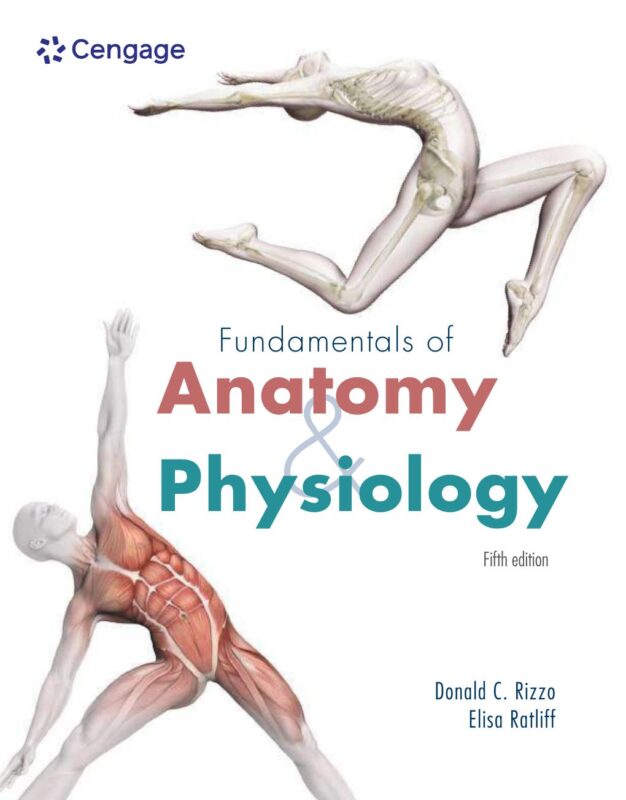
Fundamentals of Anatomy and Physiology 5th Edition By Donald Rizzo, Elisa Ratliff
$30.00
Secure checkout
Instant digital download
PDF document
Document details
- Pages
- 556
- File size
- 705.09 KB
- Format
- Digital PDF
- Category
- eBook[PDF]
Sign in or create a free account to continue. Your purchase will be saved in My Downloads.
About this ebook
Fundamentals of Anatomy and Physiology, 5th Edition by Donald C. Rizzo and Elisa Ratliff is structured into 19 comprehensive chapters designed for a one-semester introductory course. The textbook focuses on how body systems collaborate to maintain homeostasis. [1, 2]
The specific topics covered are organized chronologically below:
Part 1: Foundations of the Human Body
- Chapter 1: The Human Body – Introduction to anatomy and physiology, anatomical terminology, directional terms, body planes, cavities, and the concept of homeostasis. [1]
- Chapter 2: The Chemistry of Life – Basic chemical principles, atoms, molecules, bonds, pH, water, and organic compounds like carbohydrates, lipids, and proteins. [1, 2]
- Chapter 3: Cell Structure – Cellular anatomy, organelle functions, and the mechanisms of membrane transport. [1]
- Chapter 4: Cellular Metabolism and Reproduction – Energy production (ATP synthesis, glycolysis, aerobic respiration), protein synthesis, and cell division via mitosis and meiosis. [1]
- Chapter 5: Tissues – Structure and functions of the four primary tissue types: epithelial, connective, muscle, and nervous tissue. [1]
Part 2: Support and Movement
- Chapter 6: The Integumentary System – Structure and function of the skin, hair, nails, and sweat glands, plus skin disorders. [1, 2]
- Chapter 7: The Skeletal System – Bone tissue structure, skeletal development, and classification of the axial and appendicular skeleton. [1]
- Chapter 8: The Articular System – Classification of joints, structural features, types of body movements, and joint disorders. [1, 2]
- Chapter 9: The Muscular System – Skeletal muscle histology, mechanism of muscle contraction, major muscle groups, and muscle physiology. [1]
Part 3: Communication and Control
- Chapter 10: The Nervous System: Introduction, Spinal Cord, and Spinal Nerves – Organization of the nervous system, neurons, neuroglia, action potentials, and spinal cord anatomy.
- Chapter 11: The Nervous System: The Brain and Cranial Nerves – Major regions of the brain, cranial nerves, cerebrospinal fluid, and higher brain functions.
- Chapter 12: The Endocrine System – Major endocrine glands, hormone mechanisms, and their regulatory functions in metabolism and development. [1, 2]
Part 4: Transport and Maintenance
- Chapter 13: The Blood – Composition of blood, plasma, functions of red and white blood cells, platelets, blood typing, and clotting.
- Chapter 14: The Cardiovascular System – Anatomy of the heart, cardiac cycle, conduction system, blood vessels, and blood pressure regulation.
- Chapter 15: The Lymphatic System and Immunity – Lymphatic pathways, lymph nodes, spleen, nonspecific body defenses, and mechanisms of adaptive immunity.
- Chapter 16: The Respiratory System – Anatomy of the respiratory tract, mechanics of breathing, gas exchange, gas transport, and respiratory disorders.
- Chapter 17: The Digestive System – Anatomy of the alimentary canal and accessory organs, chemical and mechanical digestion, and nutrient absorption.
- Chapter 18: The Urinary System – Kidney structure, nephron function, urine formation, fluid-electrolyte balance, and acid-base regulation. [1, 2]
Part 5: Continuity of Life
- Chapter 19: The Reproductive System – Anatomy and physiology of the male and female reproductive systems, meiosis, and overview of human development. [1]
File included
tmpphpTMo3RN
705.09 KB
Related ebooks