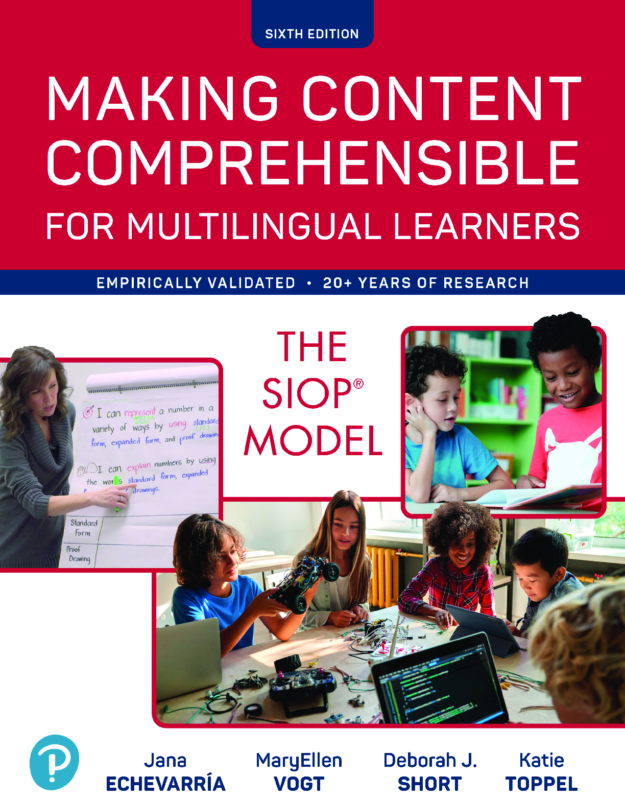
Making Content Comprehensible for Multilingual Learners: The SIOP Model 6th Edition By Jana Echevarria, MaryEllen Vogt, Deborah Short, Katie Toppel
$30.00
Secure checkout
Instant digital download
PDF document
Document details
- Pages
- 396
- File size
- 23.37 MB
- Format
- Digital PDF
- Course
- Education
- Category
- eBook[PDF]
Sign in or create a free account to continue. Your purchase will be saved in My Downloads.
About this ebook
The 6th Edition of Making Content Comprehensible for Multilingual Learners: The SIOP Model by Jana Echevarría, MaryEllen Vogt, and Deborah J. Short provides a comprehensive framework of 8 core components and 30 instructional features. It explicitly covers teaching academic content and language simultaneously. [1, 2]
Below is the structured breakdown of the specific chapters and topics covered in this edition. [1]
1. Introduction to the SIOP Model
- Demographics: Current trends regarding multilingual learners (MLs).
- Asset-Orientation: Viewing students' native languages and cultures as educational strengths.
- Research Basis: The empirical foundation of Sheltered Instruction Observation Protocol (SIOP). [1, 2, 3]
2. Lesson Preparation
- Objectives: Writing clearly defined content and language objectives.
- Concepts: Selecting age-appropriate core concepts.
- Materials: Utilizing supplementary materials (graphs, models, multimedia).
- Adaptation: Modifying content to fit all English proficiency levels. [1]
3. Building Background
- Connections: Linking new concepts to students’ personal and cultural experiences.
- Past Learning: Making explicit connections to previous lessons.
- Academic Vocabulary: Teaching content-specific and cross-curricular words systematically. [, 2, 3]
4. Comprehensible Input
- Speech Adaptation: Adjusting teacher talk, pacing, and complexity to student proficiency.
- Clarification: Explaining academic tasks step-by-step with written and oral support.
- Techniques: Using gestures, modeling, previews, and hands-on demonstrations. [, 2]
5. Strategies
- Cognitive Learning: Teaching students learning strategies like predicting and self-monitoring.
- Scaffolding: Providing temporary frameworks that are gradually removed as independence grows.
- Higher-Order Thinking: Prompting questions that require critical analysis, not just basic recall. [1]
6. Interaction
- Discussion: Maximizing meaningful student-to-student conversations.
- Grouping: Structuring diverse grouping configurations (pairs, small groups, whole class).
- Native Language Support: Allowing clarifying discussions using the student’s primary language. [, 2]
7. Practice and Application
- Hands-on Practice: Using physical manipulatives to cement abstract ideas.
- Application: Activities that apply content knowledge and language skills together.
- Language Domains: Integrating all four skills: reading, writing, listening, and speaking. [, 2, 3, 4]
8. Lesson Delivery
- Objective Support: Aligning actual classroom actions directly with written objectives.
- Engagement: Maintaining high student pacing and task attention throughout the period. []
9. Review and Assessment
- Vocabulary Review: Comprehensive wrap-up of targeted terminology.
- Feedback: Providing clear, specific feedback on language output and content knowledge.
- Assessment: Gathering data on student progress before, during, and after learning. [, 2]
10. Multi-Tiered System of Supports (MTSS)
- Tiered Frameworks: Merging SIOP strategies into general school-wide MTSS structures.
- Intervention: Identifying differences between language acquisition needs and learning difficulties. []
11. Collaborative Practices
File included
eBook-Making-Content-Comprehensible-for-Multilingual-Learners-The-SIOP-Model-6e-Jana-Echevarria-MaryEllen-Vogt-Deborah-Short-Katie-Toppel.pdf
23.37 MB
Related ebooks