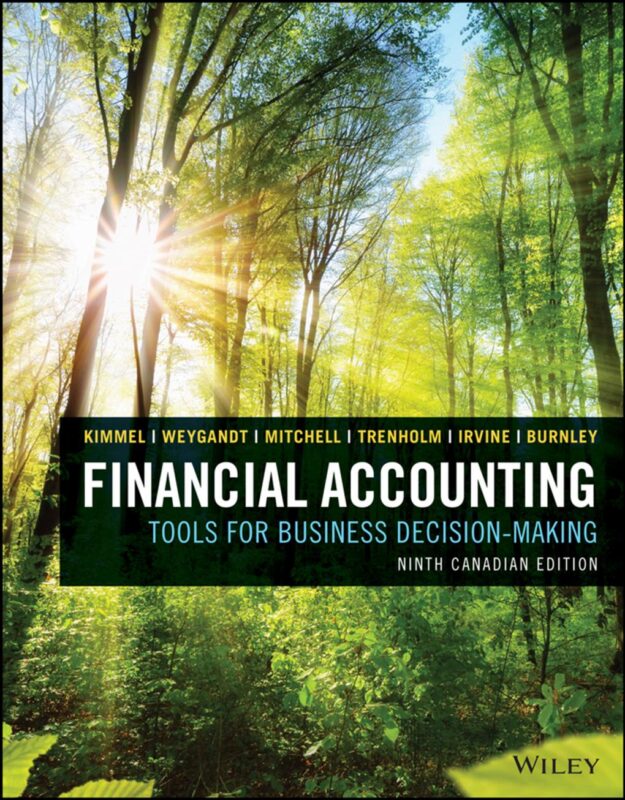
Financial Accounting: Tools for Business Decision Making 9th Canadian Edition By Paul D. Kimmel, Jerry J. Weygandt
$30.00
Secure checkout
Instant digital download
PDF document
Document details
- Pages
- 1,064
- File size
- 31.97 MB
- Format
- Digital PDF
- Course
- Accounting
- Category
- eBook[PDF]
Sign in or create a free account to continue. Your purchase will be saved in My Downloads.
About this ebook
The 9th Canadian Edition of Financial Accounting: Tools for Business Decision Making by Paul D. Kimmel, Jerry J. Weygandt, Donald E. Kieso, Barbara Trenholm, Wayne Irvine, and Christopher D. Burnley covers 14 core chapters. The textbook focuses heavily on how managers, investors, and creditors use accounting data to make strategic business decisions. [1, 2, 3, 4]
Chapter-by-Chapter Topics
- Chapter 1: The Purpose and Use of Financial Statements
- Chapter 2: A Further Look at Financial Statements
- Chapter 3: The Accounting Information System
- Chapter 4: Accrual Accounting Concepts
- Chapter 5: Merchandising Operations
- Chapter 6: Reporting and Analyzing Inventory
- Inventory cost flow assumptions (FIFO, Specific Identification, Weighted Average).
- Financial statement effects of inventory errors.
- Lower of cost and net realizable value (LCNRV). [1]
- Chapter 7: Internal Control and Cash
- Chapter 8: Reporting and Analyzing Receivables
- Chapter 9: Reporting and Analyzing Long-Lived Assets
- Chapter 10: Reporting and Analyzing Liabilities
- Chapter 11: Reporting and Analyzing Shareholders' Equity
- Chapter 12: Reporting and Analyzing Investments
- Strategic reasons for investing.
- Accounting for debt and equity investments.
- Valuation and reporting under ASPE and IFRS. [1]
- Chapter 13: Statement of Cash Flows
- Chapter 14: Performance Measurement
Integrated 9th Edition Themes
In addition to core accounting rules, this specific Canadian edition integrates several modern business tools directly into the chapters:
- Data Analytics: Includes dedicated Excel modules, visualization questions, and data analysis case studies to reflect modern accounting practice. [1, 2]
- ESG and Indigenous Perspectives: Introduces coverage on Environmental, Social, and Governance (ESG) reporting and how they factor into Canadian corporate decision-making. [1]
- IFRS vs. ASPE: Highlights the differences between International Financial Reporting Standards (public companies) and Accounting Standards for Private Enterprises (private companies) across Canada.
File included
tmpphpLUbWCn
31.97 MB
Related ebooks