
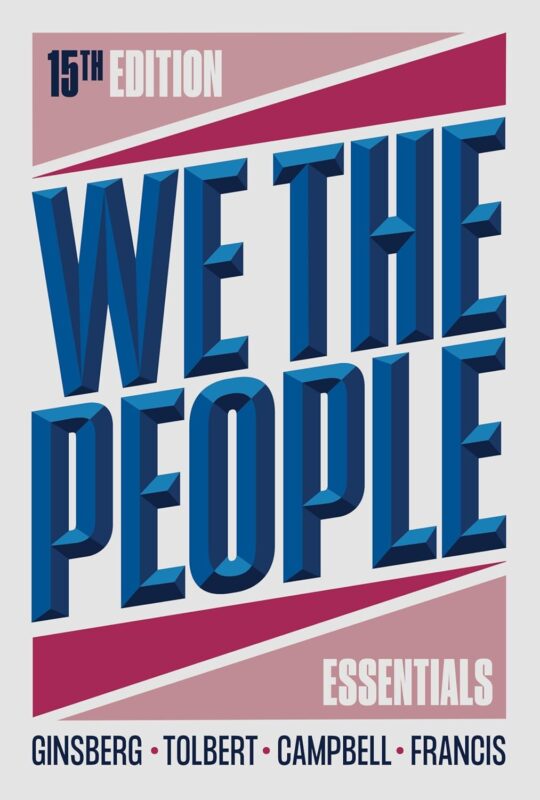
We the People 15th Edition By Benjamin Ginsberg, Caroline Tolbert, Andrea Campbell, Theodore Lowi
$30.00
Secure checkout
Instant digital download
PDF document
Document details
- Pages
- 1,192
- File size
- 32.83 MB
- Format
- Digital PDF
- Course
- Social Sciences
- Category
- eBook[PDF]
Sign in or create a free account to continue. Your purchase will be saved in My Downloads.
About this ebook
We the People, 15th Edition by Benjamin Ginsberg, Caroline Tolbert, and Andrea Campbell comprehensive covers the foundations, political behaviors, institutions, and policy outputs of the United States political system. [1, 2]
The text is divided into 18 distinct chapters in its full edition, organized across four thematic pillars: [1, 2, 3]
Part I: Foundations of American Politics
-
- Chapter 1: Americans and Their Political Values – Explores what it means to be a citizen, democratic principles, and core ideals like liberty, equality, and justice. [1]
- Chapter 2: The Founding and the Constitution – Examizes colonial conflicts, the breakdown of the Articles of Confederation, and the structural compromises of the U.S. Constitution. [1, 2]
- Chapter 3: Federalism – Details the constitutional division of power between national, state, and tribal governments. [1, 2, 3]
- Chapter 4: Civil Liberties – Covers protections against government overreach, focusing on the Bill of Rights and landmark Supreme Court rulings. [1, 2]
- Chapter 5: Civil Rights – Chronicles the constitutional protections guaranteeing equal treatment under the law and the evolution of the American civil rights movement. [1]
Part II: Political Behavior and Information
-
- Chapter 6: Public Opinion – Studies how political attitudes form, how they are socialized, and how they shift over time.
- Chapter 7: The Media and Political Information – Critiques the press, the digital news ecosystem, and how media shapes political discourse.
- Chapter 8: Political Participation and Voting – Investigates voting access, turn-out variables, and different pathways of civic activism.
- Chapter 9: Political Parties – Profiles the American two-party framework, party history, and modern polarization.
- Chapter 10: Campaigns and Elections – Details contemporary election laws, financing, and strategies, with fully integrated insights from the 2024 general election.
- Chapter 11: Groups and Interests – Looks at how special interest groups, political action committees (PACs), and lobbyists sway policy decisions. [1, 2, 3, 4, 5]
Part III: Institutions of Government
-
- Chapter 12: Congress – Unpacks the legislative process, committee structures, and the friction between national goals and local representation.
- Chapter 13: The Presidency – Dissects executive actions, expansions of executive authority, and the role of the modern president.
- Chapter 14: The Bureaucracy – Evaluates the administrative state, federal agencies, and accountability in public administration.
- Chapter 15: The Federal Courts – Maps out the structure of the judicial branch, judicial review, and how the Supreme Court functions. [1, 2, 3, 4]
Part IV: Public Policy
-
- Chapter 16: Economic Policy – Analyzes monetary and fiscal actions, government spending, and federal budget priorities.
- Chapter 17: Social Policy – Evaluates domestic platforms including healthcare, social safety nets, education, and welfare.
- Chapter 18: Foreign Policy – Breaks down national security, trade dynamics, defense, and global diplomacy. [1, 2]
Core Themes in the 15th Edition
Throughout these chapters, the 15th edition relies heavily on an analytical framework focusing on the core theme "Who Are Americans?" This edition incorporates extensive coverage on how factors like race, ethnicity, class, and gender impact individual levels of civic participation, institutional representation, and trust in the government. [1, 2, 3]
File included
tmpphpEmp4fJ
32.83 MB
Related ebooks