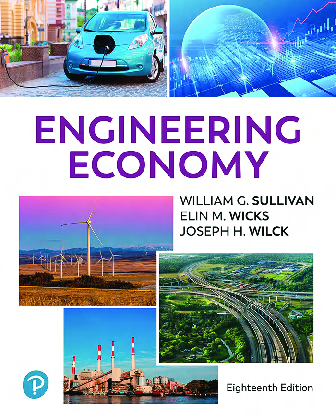
Engineering Economy 18th Edition By William G. Sullivan, Elin M. Wicks
$30.00
Secure checkout
Instant digital download
PDF document
Document details
- Pages
- 745
- File size
- 5.87 MB
- Format
- Digital PDF
- Course
- Education
- Category
- eBook[PDF]
Sign in or create a free account to continue. Your purchase will be saved in My Downloads.
About this ebook
The 18th Edition of Engineering Economy by William G. Sullivan, Elin M. Wicks, and C. Patrick Koelling covers the core methodologies, formulas, and principles necessary for engineers to make structured economic decisions in professional practice. The textbook is organized into 14 chapters structured sequentially from fundamental cash flow concepts to complex, multi-variable project evaluation. [1, 2]
Complete Table of Contents
- Introduction to Engineering Economy: Foundational concepts, the seven fundamental principles of engineering economy, and how economic analysis integrates into the engineering design process.
- Cost Concepts and Design Economics: Cost terminology (fixed, variable, direct, indirect), price-demand relationships, cost-driven design optimization, and present economy studies.
- Cost-Estimation Techniques: Integrated approaches to estimation, parametric cost estimating models, and treating cost estimation as a critical engineering phase.
- The Time Value of Money: Simple and compound interest, cash flow diagrams, the concept of economic equivalence, and interest formulas.
- Evaluating a Single Project: Determining the Minimum Attractive Rate of Return (MARR), Present Worth (PW), Future Worth (FW), Annual Worth (AW), and Internal Rate of Return (IRR).
- Comparison and Selection among Alternatives: Methods for comparing multiple mutually exclusive engineering alternatives, incremental investment analysis, and capital recovery.
- Depreciation and Income Taxes: Asset depreciation methods (such as MACRS), corporate income tax regulations, and after-tax economic analysis.
- Price Changes and Exchange Rates: Evaluating the impact of inflation, deflation, changing price vectors, and foreign currency exchange rates on engineering projects.
- Replacement Analysis: Deciding when to replace a current asset (the defender) with a new asset (the challenger), economic life of an asset, and sunk costs.
- Evaluating Projects with the Benefit−Cost Ratio Method: Applying the B/C ratio method, typically utilized for public infrastructure and government-funded engineering projects.
- Breakeven and Sensitivity Analysis: Determining breakeven points for variables and evaluating how sensitive a project's viability is to fluctuations in key assumptions.
- Probabilistic Risk Analysis: Addressing uncertainty using analytical and Monte Carlo simulation techniques (such as using Excel Data Tables for investment risk).
- The Capital Budgeting Process: How organizations allocate limited capital among competing projects, including capital rationing and project bundling.
- Decision Making Considering Multiattributes: Techniques for evaluating projects that have both non-monetary, qualitative attributes and quantitative economic attributes. [1, 2, 3, 4, 5, 6, 7]
Key Structural Features of the 18th Edition
- Case Studies: Features updated case studies spanning across twice as many chapters compared to earlier versions (such as Electric Vehicle Battery Recovery and The Economics of Daytime Running Lights). [1, 2]
- Spreadsheet Models: Integrated side-by-side comparisons of hand-worked formulas and automated Excel spreadsheet solutions. [1]
- FE Exam Practice: Includes multiple-choice practice problems at the end of each chapter formatted to prepare students for the Fundamentals of Engineering (FE) exam. [1]
- Accounting Fundamentals: Includes an integrated appendix covering basic accounting principles. [1, 2]
File included
eBook-PDF-Engineering-Economy-18th-Edition-By-William-G.-Sullivan-Elin-M.-Wicks.pdf
5.87 MB
Related ebooks