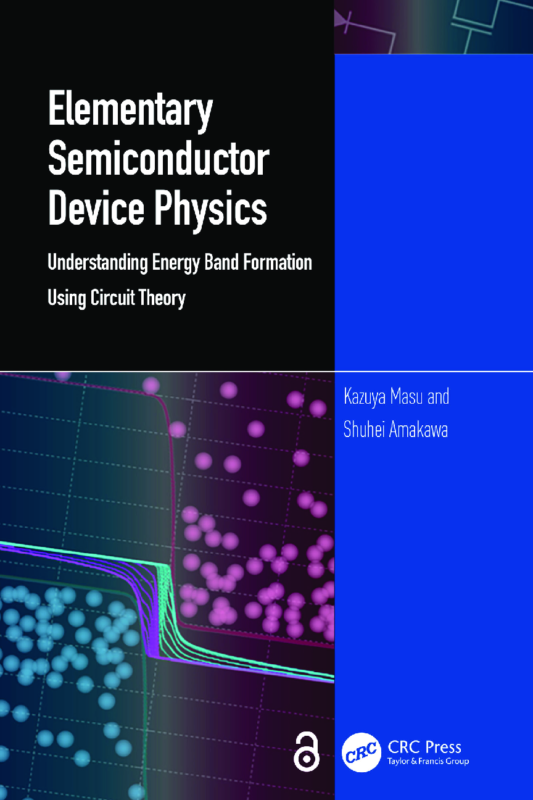
Elementary Semiconductor Device Physics: by Kazuya Masu & Shuhei Amakawa
$29.50
Secure checkout
Instant digital download
PDF document
Document details
- Pages
- 362
- File size
- 26.97 MB
- Format
- Digital PDF
- Course
- Engineering
- Category
- eBook[PDF]
Sign in or create a free account to continue. Your purchase will be saved in My Downloads.
About this ebook
Elementary Semiconductor Device Physics: Understanding Energy Band Formation Using Circuit Theory is a notable open-access textbook published by CRC Press in late 2024, co-authored by integrated circuit experts Kazuya Masu and Shuhei Amakawa. The book provides an untraditional, highly visual introduction to semiconductor device physics by using circuit theory rather than quantum mechanics to explain the formation of energy bands. [1, 2, 3]
Key Features & Core Focus
- No Quantum Mechanics Required: It teaches core physics concepts without expecting readers to have a background in quantum mechanics, making it uniquely accessible. [1]
- Circuit-Theoretic Approach: It utilizes standard circuit frameworks to demystify complex and often "indigestible" crystalline energy bands. [1]
- Focus on Quasi-Fermi Levels: The book focuses heavily on the concept of quasi-Fermi levels (originally introduced by William Shockley) to accurately explain how biased semiconductor devices behave. [1, 2]
- TCAD-Based Learning: Key energy-band diagrams are drawn using Technology Computer-Aided Design (TCAD) tools. This allows electrical engineering students and practicing engineers to build quantitative, real-world diagnostic skills. [1, 2]
About the Authors
- Kazuya Masu: Former President of the Tokyo Institute of Technology (Tokyo Tech) and an accomplished IEEE member with decades of research in electronic engineering. [1, 2, 3]
- Shuhei Amakawa: A Professor at Hiroshima University who holds engineering degrees from the University of Tokyo and a physics degree from the University of Cambridge. [1]
File included
Elementary-Semiconductor-Device-Physics-Understanding-Energy-Band-Formation-Using-Circuit-Theory.pdf
26.97 MB
Related ebooks