
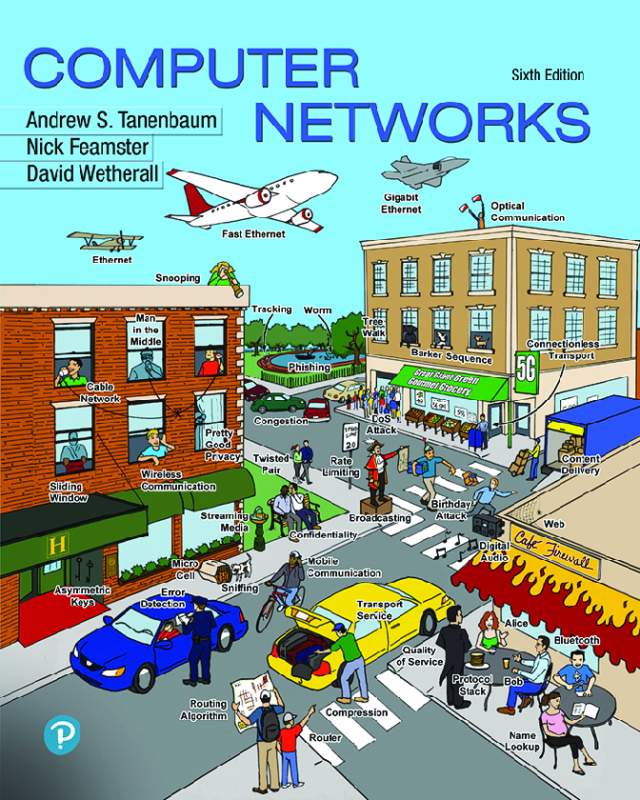
[eBook] [PDF] Computer Networks, 6th Edition By Andrew S. Tanenbaum, Nick Feamster, David J. Wetherall
$30.00
Secure checkout
Instant digital download
PDF document
Document details
- Pages
- 945
- File size
- 11.86 MB
- Format
- Digital PDF
- Course
- Computer Science
- Category
- eBook[PDF]
Sign in or create a free account to continue. Your purchase will be saved in My Downloads.
About this ebook
The 6th Edition of Computer Networks by Andrew S. Tanenbaum, Nick Feamster, and David J. Wetherall uses a structured, "inside-out" layered approach. It begins at the physical hardware level and builds upward to network applications, integrating updated coverage on modern networking paradigms. [1, 2, 3]
Core Chapter Outline & Topics Covered
- 1. Introduction
- Uses of computer networks (e.g., IoT, e-commerce, social media).
- Network hardware and types of networks (LAN, WAN, PAN, enterprise, wireless).
- Network software, protocol hierarchies, and layering principles.
- Reference models (OSI model vs. TCP/IP model).
- Standardization, policy, and legal issues. [1, 2, 3]
- 2. The Physical Layer
- Guided transmission media (copper, fiber optics).
- Wireless transmission and modulation (from waveforms to bits).
- The public switched telephone network, cable networks (including updated DOCSIS coverage), and communication satellites.
- Modern cellular networks architectures, featuring 4G and 5G networks. [1, 2, 3, 4, 5, 6]
- 3. The Data Link Layer
- 4. The Medium Access Control (MAC) Sublayer
- The channel allocation problem and multiple access protocols.
- Wired LANs and Ethernet standards, including modern 40-gigabit and 100-gigabit Ethernet.
- Wireless LANs (Wi-Fi / 802.11 protocols, including 802.11ac, 802.11ad, and 802.11ax).
- Broadband wireless (Bluetooth and RFID).
- Data link layer switching, VLANs, and virtualized networking. [1, 2, 3, 4, 5]
- 5. The Network Layer
- 6. The Transport Layer
- 7. The Application Layer
- Domain Name System (DNS): Architecture, name spaces, and modern trends like encrypted DNS and DNS privacy.
- Electronic mail (SMTP, IMAP) and email security (PGP).
- The World Wide Web: HTTP protocol, architectural components, server farms, and content distribution networks (CDNs).
- Streaming audio and video technology, featuring MPEG-DASH. [1, 2, 3, 4, 5]
- 8. Network Security
- Completely overhauled to address modern security principles and incidents.
- Cryptography basics (symmetric-key algorithms like DES/AES, public-key algorithms).
- Digital signatures, authentication protocols, and key management.
- Real-world secure communication protocols (Web security, IPSec, Firewalls, Wireless security).
- Fundamental network attack techniques and defensive actions. [1, 2, 3, 4, 5]
File included
eBook-PDF-Computer-Networks-6th-Edition-By-Andrew-S.-Tanenbaum-Nick-Feamster-David-J.-Wetherall.pdf
11.86 MB
Related ebooks