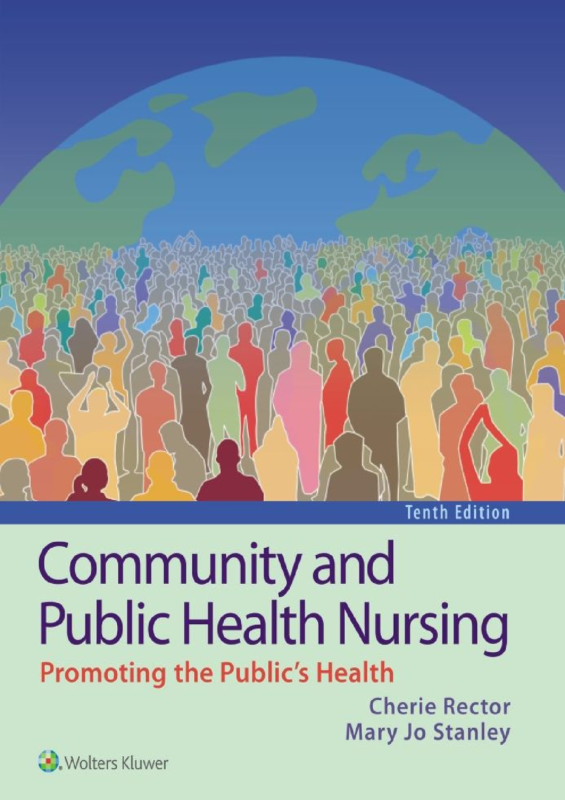
eBook Community and Public Health Nursing Promoting the Public’s Health 10th Edition By Cherie Rector, Mary Jo Stanley
$30.00
Secure checkout
Instant digital download
PDF document
Document details
- Pages
- 2,657
- File size
- 62.69 MB
- Format
- Digital PDF
- Course
- NURSING
- Category
- eBook[PDF]
Sign in or create a free account to continue. Your purchase will be saved in My Downloads.
About this ebook
The Community and Public Health Nursing: Promoting the Public’s Health (10th Edition) by Cherie Rector and Mary Jo Stanley spans 30 chapters organized into 7 comprehensive units. The textbook shifts the focus from individual client-nurse relationships to population-focused care and public health principles. [1, 2]
The detailed breakdown of units and specific topics covered includes:
Unit 1: Foundations of Community/Public Health Nursing
- Introduction to Community Health Nursing: Overview of population-focused tools, care goals, and the role of the nurse.
- Public Health Nursing in the Community: Understanding health delivery frameworks, including the Healthy People 2030 objectives.
- History and Evolution: The origin and progression of public health nursing practices over time.
- Evidence-Based Practice (EBP) & Ethics: Incorporating research-backed solutions and navigating moral dilemmas in community care.
- Transcultural Nursing: Emphasizing cultural sensitivity, cultural competence, and addressing the diverse backgrounds of populations. [1, 2, 3, 4, 5]
Unit 2: Community/Public Health Essentials
- Structure and Economics: The systemic organization and financial healthcare models behind public health services.
- Epidemiology: Tracking the distribution, determinants, and management of disease and health states within communities.
- Communicable Diseases: Prevention, containment, and management of infectious diseases.
- Environmental Health and Safety: Inspecting how human surroundings affect physical well-being. [1, 2]
Unit 3: Community/Public Health Nursing Toolbox
- Communication and Technology: Utilizing data, health informatics, and cooperative digital tools.
- Health Promotion Through Education: Designing effective health teaching and educational resources for community clients.
- Program Planning and Evaluation: Step-by-step guidance on designing, implementing, and assessing community health initiatives.
- Policy Making and Advocacy: Training nurses to act as advocates, understand political processes, and impact healthcare laws. [1, 2]
Unit 4: The Health of Our Population
- Family as Client: Applying the nursing process to family units.
- Community as Client: Treating the broader community structure as the core patient.
- Global Health Nursing: Analyzing international healthcare patterns and systemic cross-border health concerns.
- Disasters and Their Impact: Preparing for and responding to natural or man-made emergencies.
- Violence and Abuse: Identification and prevention strategies for domestic, community, and systemic abuse. [1, 2]
Unit 5: Aggregate Populations
- Maternal and Child Health: Healthcare interventions for pregnant mothers, newborns, and infants.
- School-Age Children and Adolescents: Managing youth-specific ailments, school nursing practices, and growth development.
- Adult Health: Chronic illness prevention and health maintenance strategies for the working-age population.
- Older Adults: Focused geriatric care addressing age-related clinical challenges. [1, 2]
Unit 6: Vulnerable Populations
- Working with Vulnerable People: Overview of social determinants of health and structural inequalities.
- Clients with Disabilities: Clinical and physical approaches tailored to individuals living with diverse cognitive and physical challenges.
- Behavioral and Mental Health: Addressing mental health epidemics and substance abuse within regional networks.
- Working with the Homeless: Specialized outreach for unhoused populations.
- Rural, Migrant, and Urban Communities: Adapting delivery methods to different geographic and socio-economic demographics. [1, 2, 3]
Unit 7: Settings for Community/Public Health Nursing
- Public Settings: Operations within local public health departments, correctional facilities, and federal systems.
- Private Settings: Occupational health nursing within corporations, businesses, and private clinics.
- Home Health and Hospice Care: Specialized clinical tasks for home-bound patients requiring home health, palliative, or end-of-life care. [1, 2, 3]
File included
eBook-PDF-Community-and-Public-Health-Nursing-Promoting-the-Publics-Health-10th-Edition-By-Cherie-Rector-Mary-Jo-Stanley.pdf
62.69 MB
Related ebooks