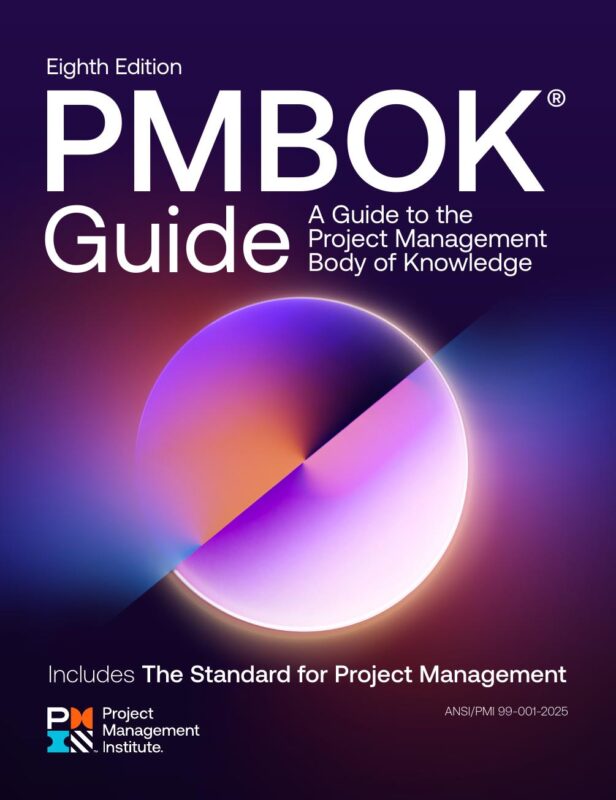
A Guide to the Project Management Body of Knowledge (PMBOK® Guide) 8th Edition By Project Management Institute
$30.00
Secure checkout
Instant digital download
PDF document
Document details
- Pages
- 401
- File size
- 16.04 MB
- Format
- Digital PDF
- Course
- Business
- Category
- eBook[PDF]
Sign in or create a free account to continue. Your purchase will be saved in My Downloads.
About this ebook
The PMBOK® Guide 8th Edition, released by the Project Management Institute (PMI), shifts project management from task completion to a system for value delivery. It connects the "why, what, and how" of project work by structuring content around six core principles, seven performance domains, and five focus areas encompassing 40 non-prescriptive processes. [1, 2, 3, 4]
The main topics and structural layers covered in the 8th Edition include:
1. The Six Core Principles (SAVE HQ)
These actionable principles guide project behaviors and cultivate the mindset necessary for modern project environments: [1, 2, 3, 4, 5]
- Sustainability: Balancing people, planet, society, and fiscal value across all project phases.
- Accountability: Fostering trust, leadership, psychological safety, and ownership of decisions.
- Value: Focusing on net customer benefits and outcomes rather than just output deliverables.
- Empower: Leveraging the team to act, collaborate, and provide feedback openly.
- Holistic: Managing interconnected risk, lifecycle stages, and stakeholder relations comprehensively.
- Quality: Meeting stakeholder expectations using criteria like fitness for use and client satisfaction. [1]
2. The Seven Project Performance Domains
The 8th Edition whittles down performance domains to seven distinct areas, integrating technical ways of working directly into them: [1, 2, 3]
- Governance: Structuring decision-making frameworks, oversight functions, and project alignment.
- Scope: Defining deliverables and organizational objectives (incorporating the renamed Develop Scope Structure, formerly WBS).
- Schedule: Time-management planning, which consolidates and streamlines previous scheduling steps.
- Finance: Managing project costs, budgets, financial health, and value optimization.
- Stakeholders: Engaging, managing, and aligning with internal and external individuals impacted by the project.
- Resources: Planning and deploying physical, infrastructure, and human capital assets.
- Risk: Identifying, analyzing, and proactively managing uncertainty and response execution. [1, 2, 3, 4, 5]
3. The Five Focus Areas (Process Groups)
The traditional Process Groups are reimagined as practical "Focus Areas," housing 40 non-prescriptive processes to accommodate predictive, adaptive, and agile transformations: [1, 2, 3, 4, 5]
- Initiating: Authorizing the project (Project Charter) and identifying impacted parties (Stakeholder Register).
- Planning: Coordinating sub-plans spanning scope, timeline, risk, sourcing strategy (formerly procurement), and communications.
- Executing: Carrying out the work, managing project knowledge, quality assurance, and leading the team.
- Monitoring and Controlling: Tracking parallel performance, budget health, change controls, and deliverable validation.
- Closing: Transferring products to operations, wrapping up vendor contracts, archiving files, and finalizing lessons learned. [1]
4. New and Emerging Macro-Topics
- Artificial Intelligence (AI): Implementing AI utilities and adapting management workflows around cognitive tech.
- Project Management Offices (PMOs): Modernizing PMO roles to function as strategic partners in value tracking.
- Procurement and Sourcing: Transitioning out of a standalone domain to integrate smoothly into sourcing execution loops.
- Product Lifecycle Thinking: Evaluating projects as iterative phases within a broader, long-term product evolution. [1, 2, 3, 4, 5]
File included
tmpphptgZUVz
16.04 MB
Related ebooks