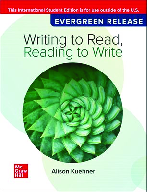
Writing to Read Reading to Write 2026 EverGreen Release By Alison Kuehner
$30.00
Secure checkout
Instant digital download
PDF document
Document details
- Pages
- 593
- File size
- 11.58 MB
- Format
- Digital PDF
- Course
- Education
- Category
- eBook[PDF]
Sign in or create a free account to continue. Your purchase will be saved in My Downloads.
About this ebook
Writing to Read, Reading to Write: 2026 Evergreen Release (2nd Edition) by Alison Kuehner is an academic textbook published by McGraw-Hill Higher Education. Released in January 2026, this foundational composition text integrates reading, writing, and critical thinking as complementary, recursive processes designed to prepare students for college-level coursework. [1, 2, 3, 4, 5]
Core Pedagogical Approach
- Integrated Literacy: The text emphasizes that reading and writing are not separate subjects but rather interlocking skills. Reading offers concrete structural examples, helps students gain background knowledge, and fuels complex text generation. [1, 2]
- Scaffolded Support: It provides heavy scaffolding and student-centered guided practice. This structure directly supports underprepared students, those in co-requisite support sections, or those transitioning into first-year college composition. [1, 2, 3]
- Inquiry-Based Design: Each chapter anchors its lessons around a central, thought-provoking question. Students practice critical thinking by analyzing, evaluating, and synthesizing texts before completing targeted essay prompts. [1, 2]
Key Publication & Product Details
- Publisher: McGraw-Hill Higher Education
- Publication Date: January 13, 2026
- Print ISBNs: 9781266514722, 1266514724
- Digital & eTextbook ISBNs: 9781265424503, 1265424500
- International Student Edition (ISE) ISBN: 9781264475445
- Page Count: Approximately 681 pages (varies slightly by format)
- Platform Formats: Available in Print, eBook, Connect access, and McGraw Hill GO. Digital versions feature interactive tools such as text-to-speech reading aloud and highlighters. [1, 2, 3, 5]
Target Audience & Flexibility
The text is uniquely engineered for community college and first-year university environments that feature highly diverse student preparation levels. Its modular structure gives instructors flexibility to change their teaching methodologies or align assignments with shifting syllabus requirements. [1, 2, 3]
File included
tmpphpT2WS62
11.58 MB
Related ebooks