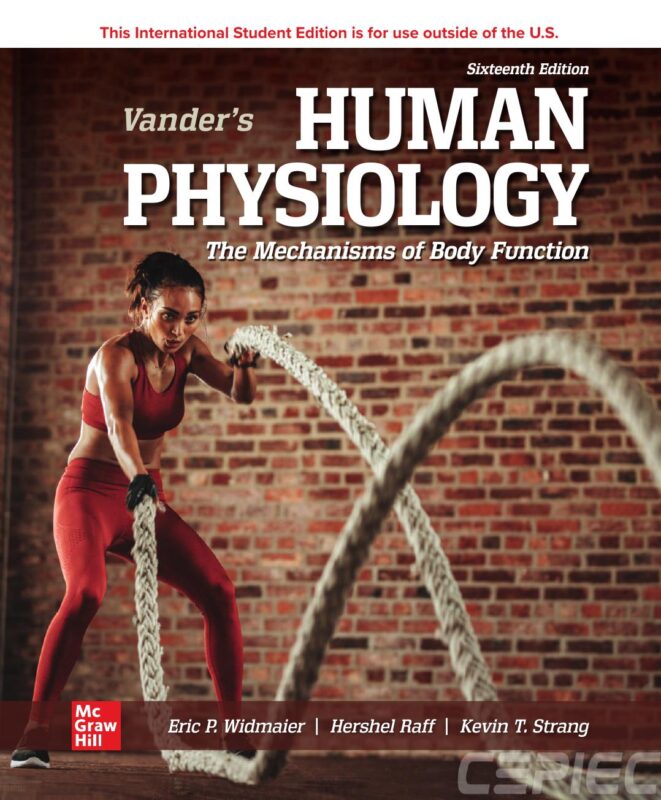
Vander’s Human Physiology: The Mechanisms of Body Function ISE 16th Edition By Eric Widmaier, Hershel Raff, Kevin Strang
$30.00
Secure checkout
Instant digital download
PDF document
Document details
- Pages
- 830
- File size
- 41.83 MB
- Format
- Digital PDF
- Course
- Human Physiology
- Category
- eBook[PDF]
Sign in or create a free account to continue. Your purchase will be saved in My Downloads.
About this ebook
Vander's Human Physiology: The Mechanisms of Body Function (16th Edition), authored by Eric Widmaier, Hershel Raff, and Kevin Strang, covers a comprehensive range of topics organized across 19 core chapters. The textbook structures human physiology through the central framework of homeostasis and the causal chains of events that allow cells, tissues, and organ systems to interact. [1, 2, 3, 4]
Part 1: Cellular and Molecular Foundations
These foundational chapters focus on the chemical, cellular, and physical principles that govern body functions:
- Chapter 1: Homeostasis: A Framework for Human Physiology – Scope of physiology, fluid compartments, and homeostatic control systems. [1, 2]
- Chapter 2: Chemical Composition of the Body and Its Relation to Physiology – Atoms, molecules, chemical bonds, and major organic biomolecules (carbohydrates, lipids, proteins, nucleic acids). [1]
- Chapter 3: Cellular Structure, Proteins, and Metabolic Pathways – Cell organelles, protein synthesis, binding sites, and metabolic pathways (glycolysis, Krebs cycle, oxidative phosphorylation). [1]
- Chapter 4: Movement of Solutes and Water Across Cell Membranes – Diffusion, mediated transport, osmosis, endocytosis, exocytosis, and epithelial transport. [1]
- Chapter 5: Cell Signaling in Physiology – Receptors, signal transduction pathways, and first/second messenger mechanisms. [1]
Part 2: Integration and Coordination
These chapters explore how the body transmits information and responds to internal or external changes:
- Chapter 6: Neuronal Signaling and the Structure of the Nervous System – Cells of the nervous system, membrane potentials, action potentials, synapses, and neuroanatomy.
- Chapter 7: Sensory Physiology – General principles of sensory receptors, somatic sensation, vision, hearing, vestibular system, taste, and smell.
- Chapter 8: Consciousness, Brain, and Behavior – Electroencephalogram (EEG), sleep, waking states, selective attention, learning, memory, emotion, and motivation.
- Chapter 9: Muscle – Structure and molecular mechanisms of skeletal, smooth, and cardiac muscle contraction.
- Chapter 10: Control of Body Movement – Motor control hierarchy, local control systems, brain motor centers, and descending pathways.
- Chapter 11: The Endocrine System – Hormone structures, transport, metabolism, mechanisms of action, and control of endocrine pathways (including thyroid and adrenal cortex). [1, 2]
Part 3: Cardiovascular and Primary Organ Systems
These chapters cover the critical transport, delivery, and balance-keeping systems of the human body:
- Chapter 12: Cardiovascular Physiology – Blood components, overall anatomy of the heart, cardiac cycle, electrical activity, hemodynamics, systemic circulation, and regulation of systemic blood pressure.
- Chapter 13: Respiratory Physiology – Mechanics of breathing, gas exchange in lungs and tissues, transport of oxygen and carbon dioxide, and control of ventilation.
- Chapter 14: Kidneys and Regulation of Water and Inorganic Ions – Glomerular filtration, tubular reabsorption/secretion, and the regulation of sodium, water, potassium, hydrogen ion balance, and blood pH.
- Chapter 15: The Digestion and Absorption of Food – Anatomy and functions of the gastrointestinal tract, regulation of GI processes, and specific nutrient digestion. [1]
Part 4: Energy, Survival, and Integration
The final section addresses overall systemic metabolism, host defense mechanisms, and life cycle physiology:
- Chapter 16: Regulation of Organic Metabolism and Energy Balance – Absorptive and postabsorptive states, endocrine regulation of metabolism, and energy expenditure/body temperature regulation.
- Chapter 17: Reproduction – Gametogenesis, anatomy and physiology of male and female reproductive systems, pregnancy, contraception, and fertility.
- Chapter 18: The Immune System – Innate and adaptive immune defenses, systemic responses to infection, and immune system diseases.
- Chapter 19: Medical Physiology: Integration Using Clinical Case Studies – Multi-system clinical cases requiring integrated application of physiological principles from all preceding chapters. [1, 2]
File included
tmpphpC4MkP8
41.83 MB
Related ebooks