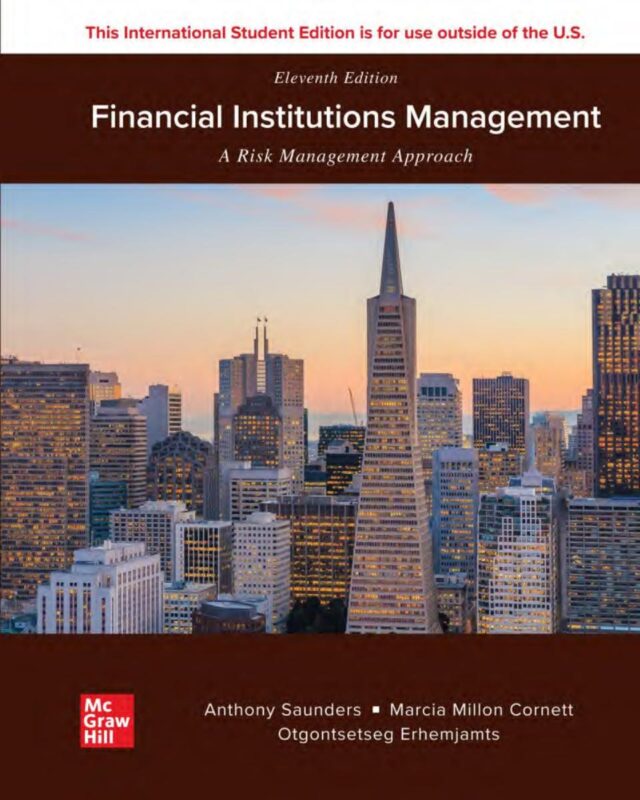
Financial Institutions Management A Risk Management Approach 11th Edition By Anthony Saunders, Marcia Millon Cornett, Otgo Erhemjamts
$30.00
Secure checkout
Instant digital download
PDF document
Document details
- Pages
- 961
- File size
- 7.6 MB
- Format
- Digital PDF
- Course
- Business
- Category
- eBook[PDF]
Sign in or create a free account to continue. Your purchase will be saved in My Downloads.
About this ebook
Get instant access to
Financial Institutions Management: A Risk Management Approach (11th Edition) by Anthony Saunders, Marcia Millon Cornett, and Otgo Erhemjamts is a leading academic textbook published by McGraw-Hill Education. It is designed for upper-level undergraduate and graduate finance students to understand how modern financial institutions balance risk and return. [1, 2]
Core Theme and Philosophy
- Risk Convergence: Risks and management styles across commercial banks, savings banks, investment banks, and insurance companies are becoming increasingly similar. [1]
- Modern Focus: Less emphasis on traditional lending and more on asset securitization, off-balance-sheet banking, and international expansion. [1]
- Macro Environment: Integrates lessons from recent global financial crises, evolving fintech landscapes, and shifting regulatory frameworks. [1]
Structure of the Text
The book logically breaks down financial management into three foundational pillars:
1. Overview of Financial Institutions
- Examines why financial institutions (FIs) are special economic entities.
- Breaks down the structural dynamics of depository institutions.
- Covers the distinct characteristics of insurance companies, securities firms, and investment banks. [1]
2. Measuring Risk
- Detailed quantitative frameworks for evaluating interest rate risk.
- Methodologies to measure credit risk and loan portfolio concentration.
- Formulas for liquid asset management, market risk, and foreign exchange risk.
- Tracking operational, technology, and off-balance-sheet risk exposures. [1, 2, 3, 4]
3. Managing Risk
- Strategic asset-liability management (ALM) frameworks.
- Utilizing financial derivatives (swaps, options, futures) to hedge exposures.
- Employing loan sales and credit derivatives to offload risk.
- Capital adequacy requirements under global standards (e.g., Basel frameworks).
File included
tmpphpeqYO58
7.6 MB
Related ebooks