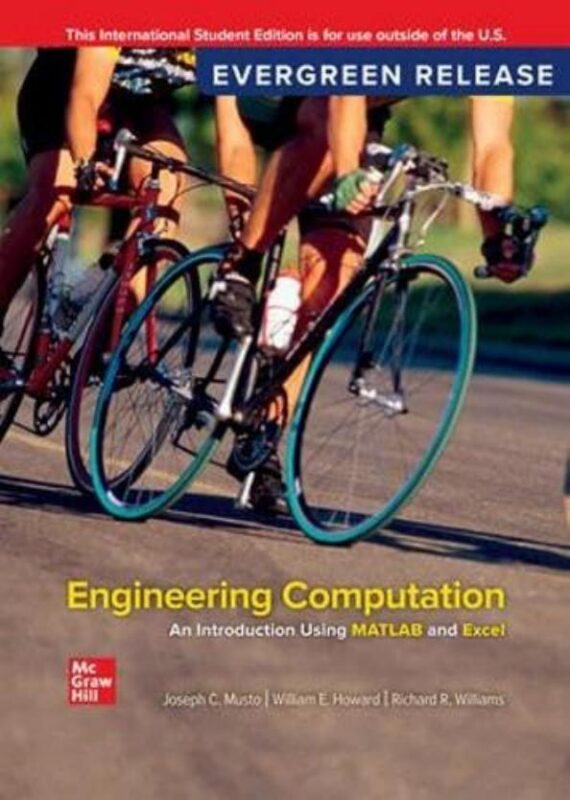
Engineering Computation An Introduction Using MATLAB and Excel 2026 Evergreen Release ISE By Joseph Musto, William E. Howard
$30.00
Secure checkout
Instant digital download
PDF document
Document details
- Pages
- 337
- File size
- 9.44 MB
- Format
- Digital PDF
- Course
- Engineering
- Category
- eBook[PDF]
Sign in or create a free account to continue. Your purchase will be saved in My Downloads.
About this ebook
ISE Engineering Computation: An Introduction Using MATLAB and Excel (2026 Release) by Joseph Musto, William E. Howard, and Richard R. Williams is a premier foundational textbook published by McGraw-Hill Education. The International Student Edition (ISE) provides first- and second-year engineering students with the essential theoretical and computational frameworks required for advanced academic study and professional practice. [1, 2]
Key Pedagogical Focus
The text bridges the gap between raw computational theory and practical, real-world application. It systemically highlights how to implement engineering algorithms across two vastly different, yet equally essential, industry-standard software ecosystems: [, 2, 3, 4]
- MATLAB: Used to teach structured procedural programming, matrix-based mathematics, logic control, and data visualization.
- Microsoft Excel: Used to master ubiquitous spreadsheet mechanics, data organization, cell-based formulas, and quick-access computational modeling. [, 2, 3, 4, 5]
Part 1: Computational Tools & Mechanics [1]
This section builds computational literacy from the ground up using granular, "keystroke-level" guided tutorials: [1, 2, 3]
- Introduction to Computational Theory: Differentiating between exact analytic mathematical solutions and algorithmic numerical solutions. [1]
- Number Representation: Deep-dive tracking of how scalars, arrays, and matrices are stored and parsed by computer processors. []
- Programming Constructs: Practical flowcharting, structural logic development, loop execution, and algorithm construction. [, 2]
- Best Practices: Developing rigorous protocols for system debugging, documenting computational solutions, and validating error tolerances. []
Part 2: Typical Engineering Applications
The second half transitions into mathematical modeling, driving software capabilities against critical engineering challenges: [, 2]
- Root Finding: Locating algebraic and transcendental equation zeros using iterative numerical processes.
- Matrix Methods & Simultaneous Equations: Resolving multi-variable physical systems using linear algebra computational frameworks.
- Numerical Integration: Computing area approximations under complex functional curves where analytic integration fails.
- Optimization: Utilizing built-in programmatic solvers to optimize design boundaries, constraints, and operational efficiency. [1]
File included
ScholarFriends.com-scholarfriendscom-ebook-pdf-ise-engineering-computation-an-introduction-using-matlab-and-e.pdf
9.44 MB
Related ebooks