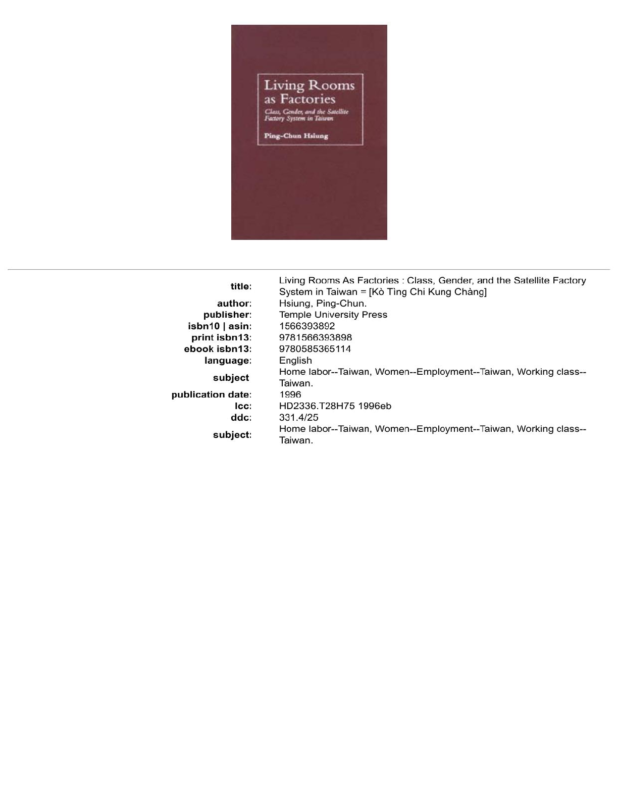
Living Rooms As Factories Class, Gender, and the Satellite Factory System in Taiwan By Ping-Chun Hsiung
$30.00
Secure checkout
Instant digital download
PDF document
Document details
- Pages
- 225
- File size
- 1.92 MB
- Format
- Digital PDF
- Course
- Education
- Category
- eBook[PDF]
Sign in or create a free account to continue. Your purchase will be saved in My Downloads.
About this ebook
Living Rooms as Factories: Class, Gender, and the Satellite Factory System in Taiwan is a seminal sociological book written by Ping-Chun Hsiung and published by Temple University Press. Based on intensive ethnographic research and the author's own experience working in small manufacturing shops, the book explores how Taiwan's "economic miracle" of the late 20th century relied heavily on the exploitation of married women working within a decentralized network of home-based factories. [1, 2, 3, 4]
💡 Core Argument & Context
During the 1970s and 1980s, Taiwan achieved massive economic growth driven by low-cost, export-oriented manufacturing. To promote this, the Taiwanese government launched a national slogan: "Living Rooms as Factories". [1, 2, 3]
- The Satellite Factory System: Instead of massive centralized plants, the economy relied on thousands of small-scale subcontracting factories (under 30 employees). These were nestled directly in living rooms, front yards, and urban residential spaces. [1, 2, 3]
- The Hidden Workforce: By bringing subcontracts directly into the domestic space, the state and capital successfully mobilized a massive, untapped labor pool—married women. [1, 2]
⚖️ The Intersection of Capitalist Logic and Patriarchy
Hsiung demonstrates that Taiwan's economic success did not happen despite traditional patriarchal family structures, but precisely because of them. [1]
- The Ideology of the Ideal Wife: Capitalists and state policies weaponized traditional expectations of women as self-sacrificing wives, mothers, and daughters-in-law. Women were told they could contribute financially to the family without abandoning their household duties. [1, 2, 3]
- Unpaid and Underpaid Labor: Inside these family-run satellite shops, women's manufacturing labor was often structurally obscured. Their work was treated as an extension of "housework" or "family help," allowing owners to bypass minimum wage laws, healthcare, and labor regulations. [1, 2]
📉 Class Divergence vs. Gender Solidarity
One of the book's major sociological contributions is its analysis of class stratification among women. Hsiung highlights two primary groups of women in this ecosystem: [1, 2]
- The Boss's Wives (Laoban Niang): Women who experienced upward social mobility by marrying into the families that owned the small shops.
- The Wage Workers: Ordinary married women hired from the neighborhood to do the assembly line work. [1, 2, 3]
While both groups of women recognized and suffered under patriarchal constraints and gender inequality, their differing class affiliations prevented them from uniting. The Laoban Niang frequently acted as agents of management, enforcing oppressive labor speed-ups and policing the workers to protect their family's capital. [1]
✊ Everyday Resistance and Agency
Despite the heavy system of surveillance and exploitation, the book highlights that Taiwanese women were not passive victims. Hsiung documents how home-based workers deployed clandestine tactics of everyday resistance to reclaim their autonomy: [1, 2]
- Purposely slowing down production speeds.
- Taking unauthorized breaks when the boss left the room.
- Covering up for each other's mistakes to subvert managerial control. [1, 2]
📖 Publication Details
- Author: Ping-Chun Hsiung (Professor of Sociology at the University of Toronto)
- Publisher: Temple University Press (1996)
- Methodology: Feminist ethnography, qualitative interviews, and participant observation (the author personally worked in six of these satellite factories making items like wooden jewelry boxes). [1, 2, 3, 4]
File included
tmpphppqvoWp
1.92 MB
Related ebooks