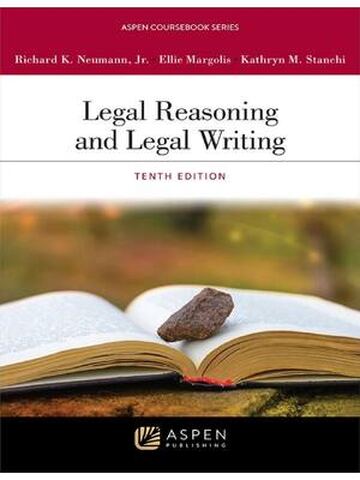
Legal Reasoning and Legal Writing 10th Edition By Richard Neumann, Ellie Margolis, Kathryn Stanchi
$30.00
Secure checkout
Instant digital download
PDF document
Document details
- Pages
- 264
- File size
- 5.25 MB
- Format
- Digital PDF
- Course
- Education
- Category
- eBook[PDF]
Sign in or create a free account to continue. Your purchase will be saved in My Downloads.
About this ebook
Legal Reasoning and Legal Writing (10th Edition) by Richard K. Neumann, Ellie Margolis, and Kathryn M. Stanchi is a comprehensive textbook designed to teach law students how to analyze legal problems and communicate solutions professionally. Published by Aspen Publishing, it bridges the gap between critical thinking and structural legal execution. [1, 2, 3, 4]
The core topics and structural breakdown covered in the 10th edition include:
⚖️ Foundations of Law & Legal Reasoning
- Introduction to the American Legal System: Where law comes from, types of law-making bodies, and the relationship between judges and legislatures.
- Rule-Based Analysis: How to extract, dissect, and interpret statutory and common-law rules.
- Case Briefing & Interpretation: Analyzing judicial decisions, determining holdings, and utilizing the doctrine of stare decisis. [1, 2, 3]
📝 The Legal Analysis Framework
- The Paradigm for Organizing Legal Proof: Deconstructing the legal analysis framework (historically built around the IRAC/CRuPAC structures) to organize a proof for a conclusion of law.
- Applying Rules and Precedents: Techniques for matching or distinguishing facts against existing legal precedent.
- Statutory Interpretation: Principles of reading, construing, and working with complex statutory text. [1, 2, 3, 4]
📂 Objective and Predictive Writing
- Office Memoranda: Formulating complete objective legal memos that assess the strengths and weaknesses of a client's legal position.
- Professional Correspondence: Drafting clear, accessible client advice letters, demand letters, and professional email correspondence.
- Oral Reports: Best practices for delivering concise, structured verbal summaries of legal research to supervising attorneys. [1, 2, 3, 4, 5]
🏛️ Persuasive Writing and Advocacy
- Developing a Persuasive Theory: Formulating a legal and factual narrative designed to convince a court. [1, 2]
- Motion Memoranda: Writing persuasive briefs for trial-level courts. [1, 2, 3]
- Appellate Briefs: Drafting formal arguments for appellate courts, including point headings, statements of the case, and questions presented. [1, 2]
- Oral Arguments: Strategies for presenting persuasive litigation arguments to panels of judges and responding to tough questions from the bench. [1, 2]
✍️ Process, Style, and Mechanics
- The Writing Process: Strategies for moving from raw research notes into clean, structured drafts.
- Effective Prose and Legal Style: Eliminating "legalese" in favor of precise language, proper paragraphing, and professional document design.
- Citations and Quotations: Formatting authority accurately using current legal citation standard rulebooks. [1, 2, 3, 4]
🤖 New to the 10th Edition
- Emerging Technologies: Grounding guidelines on how to navigate artificial intelligence (AI) and large language models (LLMs) as research and drafting aids while avoiding ethical pitfalls. [1]
- Modern Legal Practice Realities: Practical advice tailored toward navigating contemporary trends in language, remote/online legal practice, and digital workflows. [1, 2]
- Refined Analytics: Streamlined research warnings, modern illustrative examples, and updated analytical structures. [1]
File included
tmpphpcUsaa3
5.25 MB
Related ebooks