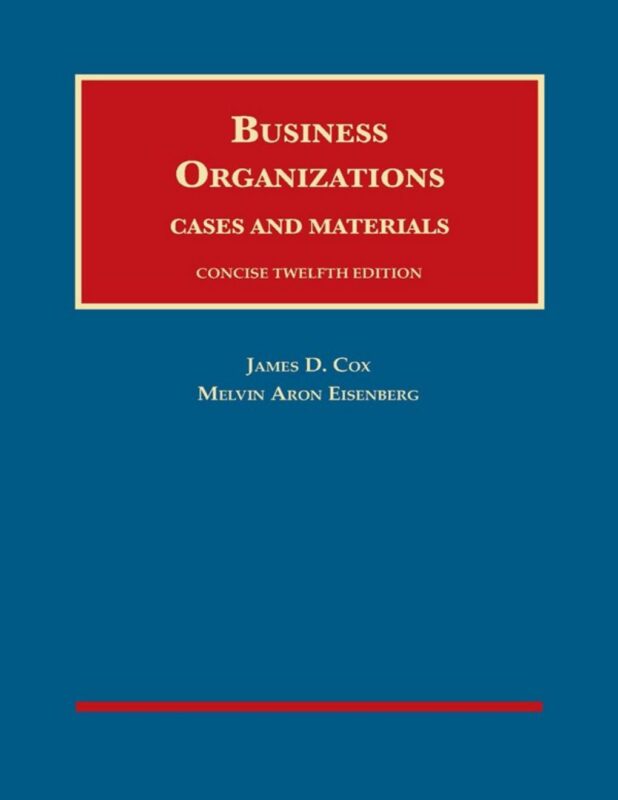
Business Organizations, Cases and Materials, Concise 12th Edition By James Cox, Melvin Eisenberg
$30.00
Secure checkout
Instant digital download
PDF document
Document details
- Pages
- 785
- File size
- 7.11 MB
- Format
- Digital PDF
- Course
- Business
- Category
- eBook[PDF]
Sign in or create a free account to continue. Your purchase will be saved in My Downloads.
About this ebook
The textbook Business Organizations: Cases and Materials, Concise 12th Edition, authored by James D. Cox and Melvin A. Eisenberg, provides a comprehensive overview of corporate and business law. It is designed for law school courses (typically titled "Corporations," "Business Organizations," or "Business Associations"). [1, 2, 3, 4]
The concise 12th edition blends traditional legal rules with rich note materials, empirical data, and competing legal approaches. The primary topics and structural categories covered include: [1]
🗒 1. Foundations of Agency Law
- The Agency Relationship: Creation of agency, definition of a legal agent, and the distinction between employees and independent contractors.
- Contractual Liability: Concepts of actual authority (express or implied), apparent authority, inherent agency power, and ratification.
- Tort Liability: The doctrine of respondeat superior and principal liability for the actions of independent contractors or agents.
- Fiduciary Duties of Agents: The agent's duty of loyalty, care, and obedience to the principal. [1]
🗒 2. Partnerships and Unincorporated Associations
- General Partnerships: Definition, formation, default rules under the Uniform Partnership Act (UPA/RUPA), management rights, financial allocations, and the high standard of fiduciary duties among partners.
- Partnership Dissolution: Dissociation, winding up, and terminating a partnership business.
- Limited Partnerships (LPs): Structure, creation, and the distinct roles of general versus limited partners. [1, 2]
🗒 3. Modern Unincorporated Business Forms
- Limited Liability Partnerships (LLPs): Specific statutory rules, protection from vicarious liability, and applications for professional firms. [1, 2, 3]
- Limited Liability Companies (LLCs): Formation, the operating agreement, management structures (member-managed vs. manager-managed), default fiduciary duties, and the standard rules for piercing the LLC veil. [1, 2, 3, 4]
🗒 4. Corporate Formation and Structure
- The Incorporation Process: Promoters' liability, drafting the articles of incorporation, bylaws, and organization meetings.
- The Corporate Form: Distinctive attributes including legal personality, centralized management, free alienability of shares, and limited liability.
- Defective Incorporation: The de facto corporation doctrine and corporation by estoppel.
- Allocation of Power: The statutory division of power between shareholders, directors, and executive officers. [1, 2, 3]
🗒 5. Piercing the Corporate Veil
- Disregarding the Corporate Entity: Alter-ego and instrumentality doctrines, undercapitalization, and corporate formalities.
- Liability Frameworks: Contract vs. tort contexts and parent-subsidiary piercing rules. [1, 2, 3]
🗒 6. Corporate Governance and Shareholder Voting
- Shareholder Action: Annual and special meetings, notice requirements, quorums, and voting mechanics (straight vs. cumulative voting).
- Proxy System: Federal proxy rules, regulation of disclosures, and shareholder proposals.
- Books and Records: Shareholder rights to inspect corporate books, ledgers, and minute books. [1, 2, 3]
🗒 7. Fiduciary Duties of Directors and Officers
- The Duty of Care: The standards of managerial oversight and the application of the Business Judgment Rule (BJR).
- The Duty of Loyalty: Conflicts of interest, self-dealing transactions, executive compensation, and the corporate opportunity doctrine.
- Good Faith and Oversight: The evolution of director monitoring responsibilities (Caremark duties). [1, 2]
🗒 8. Shareholder Litigation
- Direct vs. Derivative Suits: Distinguishing between individual injury and injury to the corporation.
- Procedural Hurdles: The demand requirement, demand futility, and the role of Special Litigation Committees (SLCs). [1, 2]
🗒 9. Closely Held Corporations
- Control Devices: Shareholder voting agreements, voting trusts, and irrevocable proxies.
- Transfer Restrictions: Buy-sell agreements and limits on share alienability.
- Oppression and Dissolution: Fiduciary duties among shareholders in close corporations and remedies for "freeze-outs." [1, 2]
🗒 10. Mergers, Acquisitions, and Takeovers
- Fundamental Corporate Changes: Asset sales, statutory mergers, and triangular mergers.
- Appraisal Rights: Shareholder rights to dissent and demand the fair value of their stock.
- Hostile Takeovers: Defensive mechanisms (e.g., poison pills), tender offer regulations, and the heightened fiduciary standards applied during changes of control (Unocal and Revlon doctrines). [1, 2, 3]
File included
tmpphpqO7smG
7.11 MB
Related ebooks