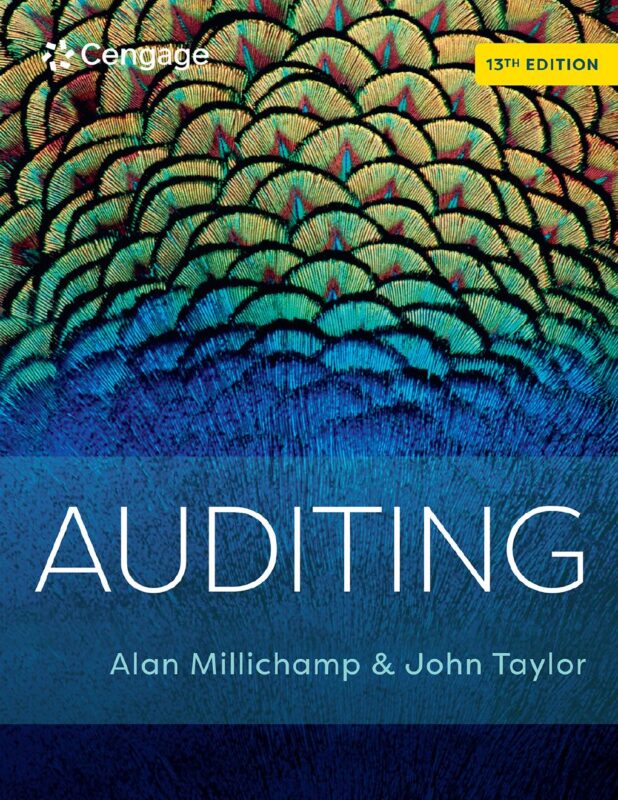
Auditing 13th Edition By John Taylor, Alan Millichamp
$30.00
Secure checkout
Instant digital download
PDF document
Document details
- Pages
- 719
- File size
- 19.56 MB
- Format
- Digital PDF
- Course
- Business
- Category
- eBook[PDF]
Sign in or create a free account to continue. Your purchase will be saved in My Downloads.
About this ebook
The 13th edition of Auditing by John Taylor and Alan Millichamp covers the core principles, practices, and theoretical frameworks of modern auditing. This specific edition strongly emphasizes auditing in the Industry 4.0 era, updated International Standards on Auditing (ISAs), corporate governance, and essential professional soft skills. [1, 2]
The textbook is divided into comprehensive thematic sections detailing the following key topics:
Foundations and Regulatory Environment
- The Why of Auditing: Introduction to the fundamental purpose, philosophy, and history of the audit function.
- Corporate Governance: Evaluation of the control environment, management accountability, and audit committee oversight.
- Professional and Ethical Frameworks: Legal responsibilities, professional skepticism, integrity, independence, and objectivity rules for auditors. [1, 2]
The Audit Process and Methodology
- Audit Risk Assessment: Planning and understanding the client's business, materiality levels, and identifying significant risk areas.
- Internal Control Systems: Documenting, evaluating, and testing a company's internal controls and financial data tracking.
- Audit Evidence and Sampling: Methods for gathering reliable evidence, physical verification, and analytical review procedures.
Substantive Testing and Reporting
- Audit of Financial Statement Categories: Step-by-step procedures for auditing transaction cycles (sales, purchases, payroll) and balances (inventory, cash, fixed assets).
- Finalization and Review: Assessing going concern status, subsequent events, and overall final analytics.
- The Auditor's Report: Forms of audit opinions, critical audit matters (CAMs), and statutory reporting duties. [1]
Modern Evolution & Specialized Fields
- Auditing in Industry 4.0: Evaluating automated processes, cloud accounting systems, big data analytics, and artificial intelligence in financial reporting. [1]
- The Modern Auditor Role: Development of soft skills such as critical thinking, adaptive communication, and flexibility in a technology-driven workplace. [1]
- Public Sector Auditing: Compliance, performance audits, and value-for-money evaluations across governmental and public bodies. [1]
File included
tmpphpbnilt6
19.56 MB
Related ebooks