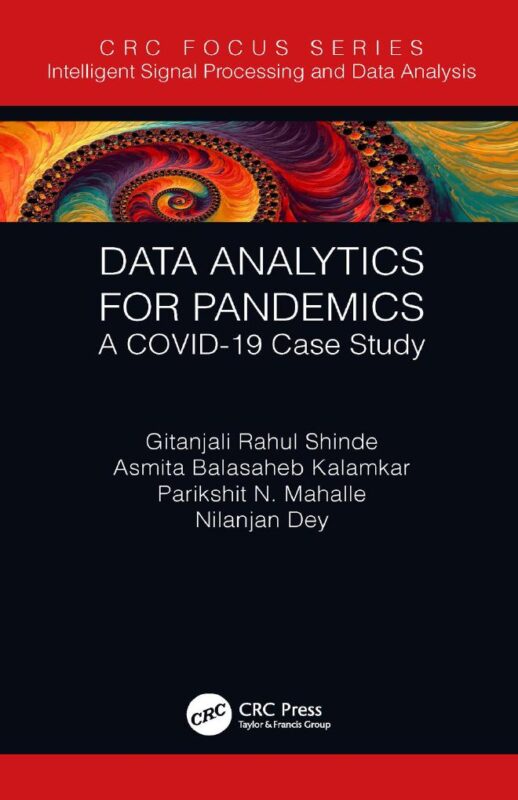
Data Analytics for Pandemics: A COVID-19 Case Study 1st Edition by Gitanjali Rahul Shinde , Asmita Balasaheb Kalamkar , Parikshit N. Mahalle, Nilanjan Dey
$44.00
Secure checkout
Instant digital download
PDF document
Document details
- Pages
- 85
- File size
- 3.33 MB
- Format
- Digital PDF
- Course
- Health Care
- Category
- eBook[PDF]
Sign in or create a free account to continue. Your purchase will be saved in My Downloads.
About this ebook
"Data Analytics for Pandemics: A COVID-19 Case Study" (1st Edition), written by Gitanjali Rahul Shinde, Asmita Balasaheb Kalamkar, Parikshit N. Mahalle, and Nilanjan Dey, is part of the Intelligent Signal Processing and Data Analysis book series published by CRC Press/Taylor & Francis.
The book focuses on how artificial intelligence, big data analytics, and statistical modeling are implemented to track, model, and mitigate global health crises. The official table of contents outlines the major topics covered:
1. COVID-19 Outbreak
- Foundational Overviews: Introduction to public health crises, defining the characteristics of epidemics versus pandemics, stages of disease transmission, and pandemic phases.
- The Pathogen & Risk Assessment: A medical overview looking at the nature and spread of the novel coronavirus alongside the formulation of a Vulnerability Index.
2. Data Processing and Knowledge Extraction
- Data Logistics: Identifying available data sources, handling related challenges (such as inconsistent datasets), and evaluating storage services, data warehousing, and cloud platforms optimized for big data.
- Data Pipeline Management: Techniques for data preparation and data cleaning to handle noisy or outlier data points.
- Knowledge Extraction: Methodologies used to extract actionable insights based on diverse data types.
3. Big Data Analytics for COVID-19
- Analytical Frameworks: Statistical parameters and predictive analytics used to model epidemic trend lines and timeline progressions.
- Data Modeling & Performance: The phases of data modeling, the deployment of Ensemble Data Models, and checking model performance metrics.
- Core Big Data & Machine Learning Techniques: Detailed looks into specific algorithms used for pandemic tracking:
- Association Rule Learning
- Classification Tree Analysis
- Genetic Algorithms
- Machine Learning and Regression Analysis (including specialized formulas like Advanced Recovery Rate and Advanced Mortality Rate)
- Social Network Analysis (often used for contact tracing or public sentiment tracking)
- Tools and Technology: An overview of the computing software, tools, and environments used by data analysts and epidemiologists.
4. Mitigation Strategies and Recommendations
- Control Interventions: Translating data models into public health policies to minimize infection rates.
- Case Studies: Real-world analytics scenarios evaluating what strategies worked effectively to manage and control pandemic spread.
File included
tmpphpPIZ6gT
3.33 MB
Related ebooks