
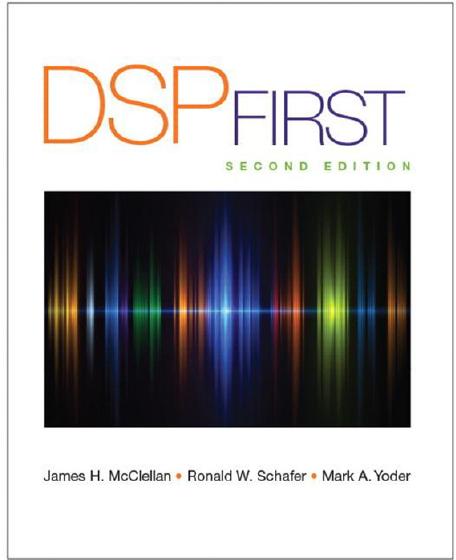
DSP First 2nd Edition By James McClellan, Ronald Schafer, Mark Yoder
$30.00
Secure checkout
Instant digital download
PDF document
Document details
- Pages
- 583
- File size
- 11.87 MB
- Format
- Digital PDF
- Course
- Education
- Category
- eBook[PDF]
Sign in or create a free account to continue. Your purchase will be saved in My Downloads.
About this ebook
The second edition of DSP First by James H. McClellan, Ronald W. Schafer, and Mark A. Yoder introduces fundamental digital signal processing concepts with a strong emphasis on mathematical intuition and MATLAB/LabVIEW implementation. [1, 2]
Compared to the original edition, the 2nd Edition expands significantly with dedicated coverage of continuous and discrete transformations, introducing three entirely new chapters (the Fourier Series, Discrete-Time Fourier Transform, and the Discrete Fourier Transform). [1]
Chapter-by-Chapter Core Topics
According to the official Georgia Tech DSP First resources, the text is structured into the following primary chapters and mathematical appendices:
- Chapter 1: Introduction – Covers the basic mathematical representation of signals and systems, and how systems act as processing building blocks.
- Chapter 2: Sinusoids – Reviews basic sine and cosine functions, tuning-fork frequency experiments, time-shift vs. phase delay, and the Phasor Addition Theorem.
- Chapter 3: Spectrum Representation – Explores the frequency-domain perspective, complex exponentials, and analyzing a signal's constituent frequencies.
- Chapter 4: Sampling and Aliasing – Explains continuous-to-discrete conversion, the Nyquist sampling rate, quantization, and fold-over effects (aliasing).
- Chapter 5: FIR Filters – Introduces Finite Impulse Response filters, moving average systems, and time-domain convolution.
- Chapter 6: Frequency Response of FIR Filters – Bridges time and frequency domains by looking at how FIR filters attenuate or pass specific steady-state sinusoidal frequencies.
- Chapter 7: Discrete-Time Fourier Transform (DTFT) – Covers the transformation framework for analyzing discrete, non-periodic signals in the frequency domain.
- Chapter 8: Discrete Fourier Transform (DFT) – Details the finite, discrete computation framework (including Fast Fourier Transform / FFT concepts) crucial for actual computational implementations.
- Chapter 9: z-Transforms – Introduces the z-domain, poles and zeros, system functions, and stability analysis for discrete systems.
- Chapter 10: IIR Filters – Explores Infinite Impulse Response filters, feedback systems, and recursive filter design structures. [1, 2, 3, 4, 5, 6]
File included
tmpphpgQg0BB
11.87 MB
Related ebooks


